


Francis Bacon is one of those artists who, despite having been looked at endlessly, never quite releases his grip. He occupies a peculiar place not only in art history but in our nervous system itself. His paintings are meant to work directly on what he called—sensation—subjecting the viewer to a kind of psychic pressure that does not dull with familiarity. This may explain why Bacon never seems to recede. There is always an exhibition somewhere, a new book or periodical, an active foundation, a scholarship circulating between institutions, another occasion to return to his work. Like a human solar system: the activity around him is continuous, almost rhythmic. It suggests an artist who will not pass into historical quiet, whose work remains structurally contemporary because it continues to act directly on perception. For that reason alone, Bacon feels less like a closed chapter than an ongoing encounter, and an especially apt figure for a sustained return.
Slow Looking 2026 | Slow Looking February: Francis Bacon | Ways of Looking
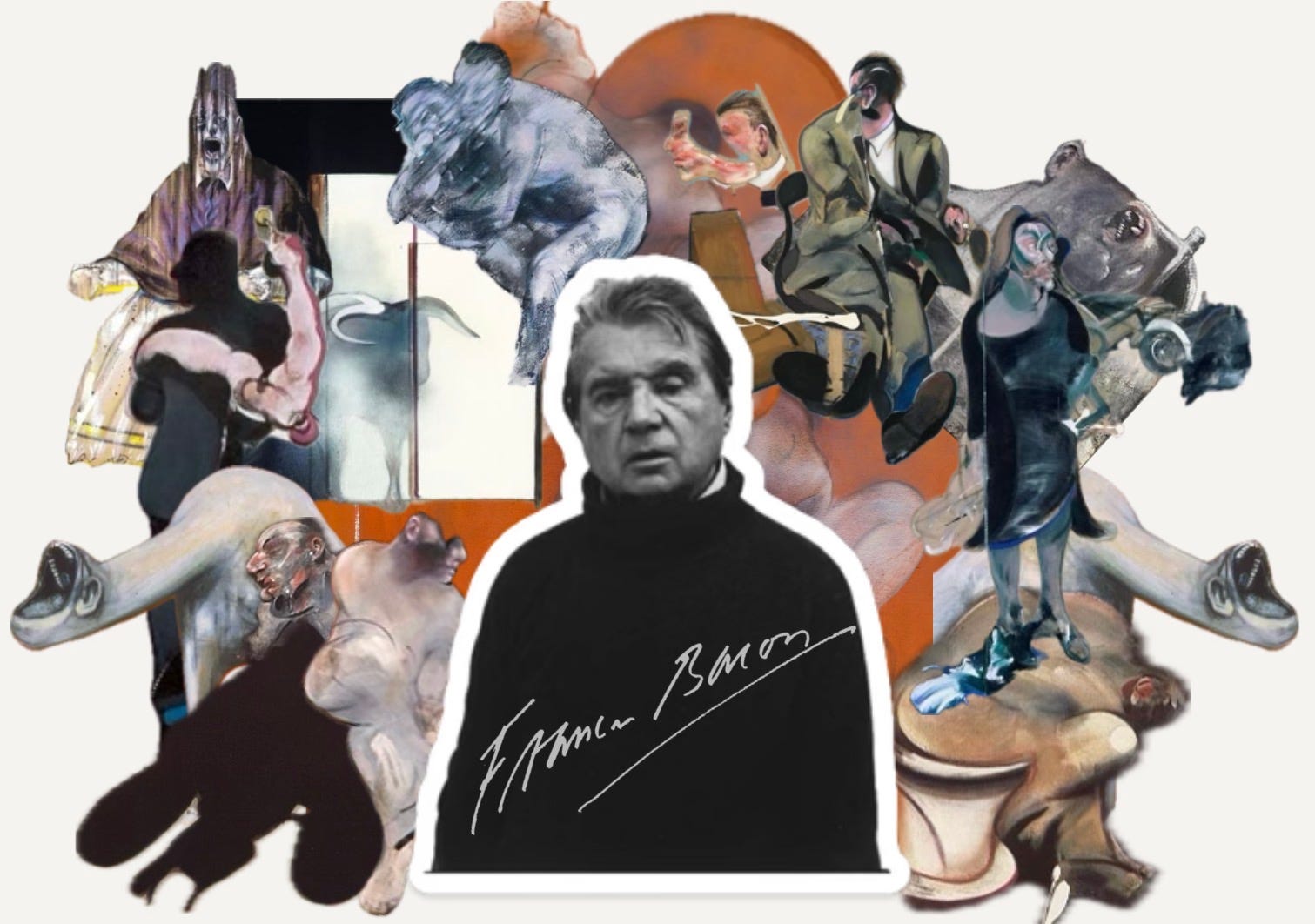
How do you introduce the work of an artist whose images are instantly recognizable, yet whose full range cannot be shown or summarized in a single view? Any attempt to introduce Francis Bacon requires compression—not because his work is repetitive, but because its meaning emerges through accumulation, variation, and return. The selection is deliberately limited. It resists both the shortcut of familiarity and the illusion of a single, representative view.
I have lived with Bacon’s work for years, including as the focus of my art-historical research during my studies, and reducing it to a single progression makes clear how resistant it is to summary. The gallery that follows is therefore a specific attempt to make his pictorial vocabulary legible: how it forms, stabilises, and later begins to loosen again, including works that are less iconic but essential to understanding the scale and coherence of his practice.
Preparing this gallery required moving slowly through Bacon’s work decade by decade, rather than returning to the familiar canon of triptychs and contorted figures. Seen this way, the work opens out. Alongside the images that have come to define him publicly is a much larger body of quieter, stranger, and less frequently reproduced paintings, revealing an extraordinary range of painterly approaches. Bacon’s reputation rests on a handful of iconic motifs. His practice, however, was far broader and less uniform than it is often assumed to be. This selection grows out of that realisation: that to understand Bacon at all, it is necessary to look beyond what we think we already know.

I. Before Bacon became “Bacon”
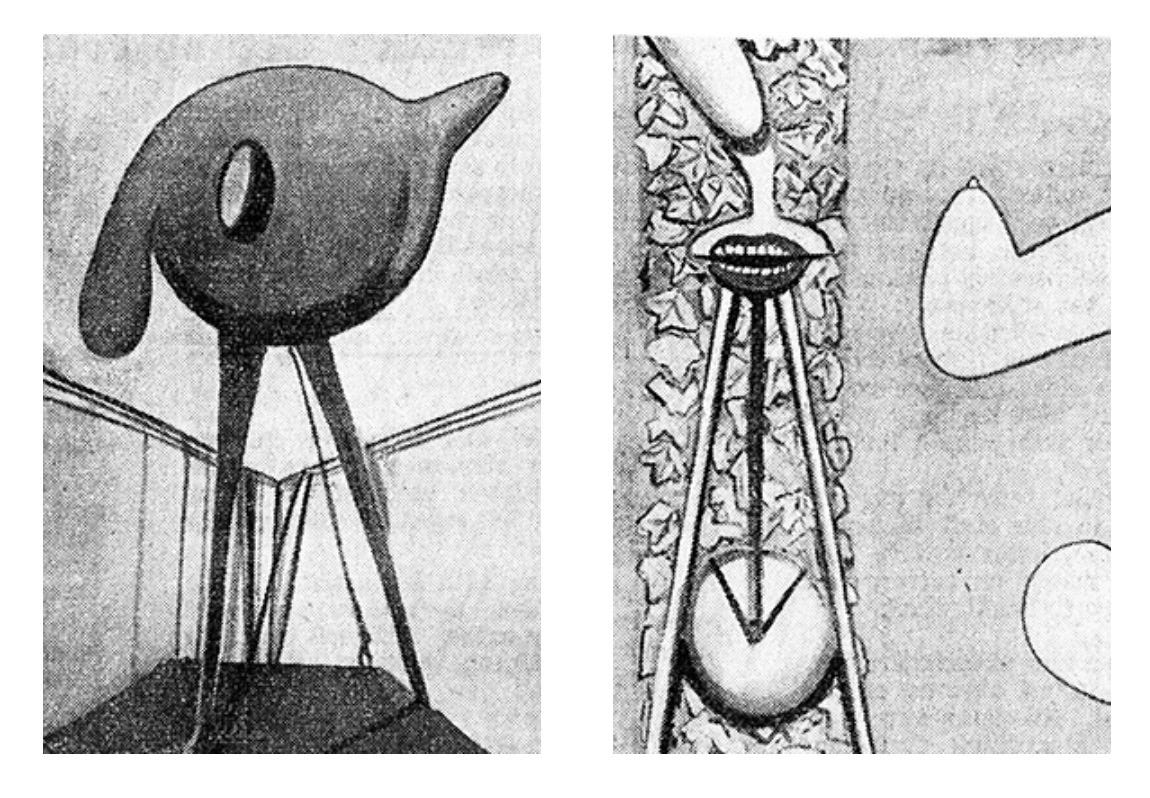
These early works matter less for their resolution than for the way they already begin to circle a recognisable problem. Before committing himself fully to painting, Bacon was active in interior design, and his earliest surviving works draw on European Modernism and Surrealism rather than a settled personal style. Their shallow, elusive spaces, biomorphic distortions, and uncertain figures suggest a painter testing how a body might be held within a pictorial frame, without yet knowing how to return to figuration with force.
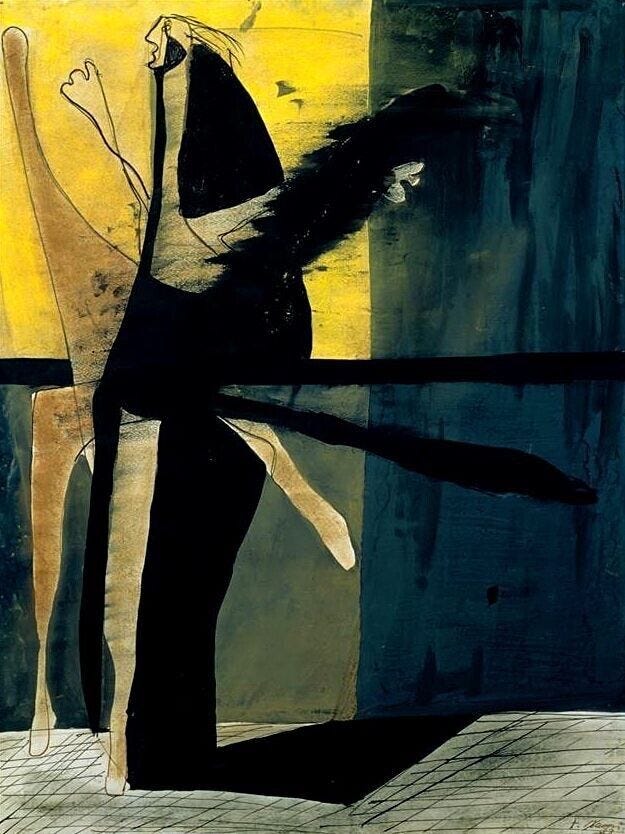
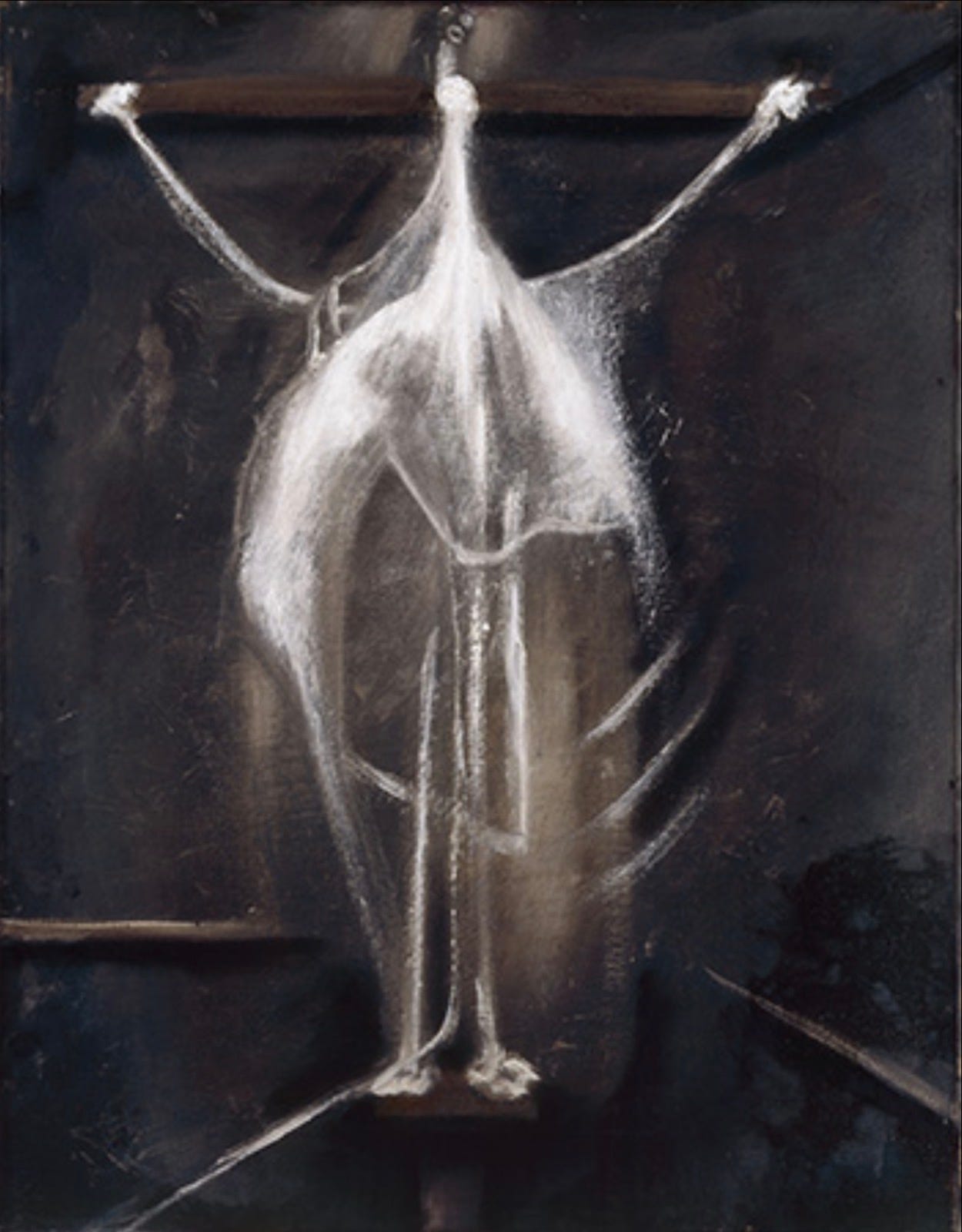
Bacon later dismissed much of this early work, additionally David Sylvester observed that there was “not much consistency in what he did, in style or in quality, until the 1940s.” That judgment is broadly fair. Yet it risks flattening what is already distinctive. Crucifixion (1933), with its attenuated white figure suspended against a dark ground, is not merely an early experiment but an image that has continued to exert force. Damien Hirst, who owns the painting, has described Bacon at this stage as “grasping for something in the shadows.” The phrase is apt. Even here, something is already hatching: an unstable body, an enclosing space, and a pressure between the two that would become central to Bacon’s work. Seen from the later paintings, these early images do not dissolve into their influences; they mark the moment when a singular language first becomes visible.
II. The Shock of Arrival
With Three Studies for Figures at the Base of a Crucifixion (1944), Bacon’s work changes abruptly. First shown in London in 1945, the triptych caused what contemporaries described as “total consternation.” Three contorted, screaming figures, set against a hot orange ground, confront the viewer with a body no longer mediated by abstraction or symbolism, but violently exposed. For Bacon, these figures were the Eumenides from Aeschylus’ Oresteia,1 but their force lies less in reference than in impact. Figuration returns not as description, but as an event from which there is no retreat.
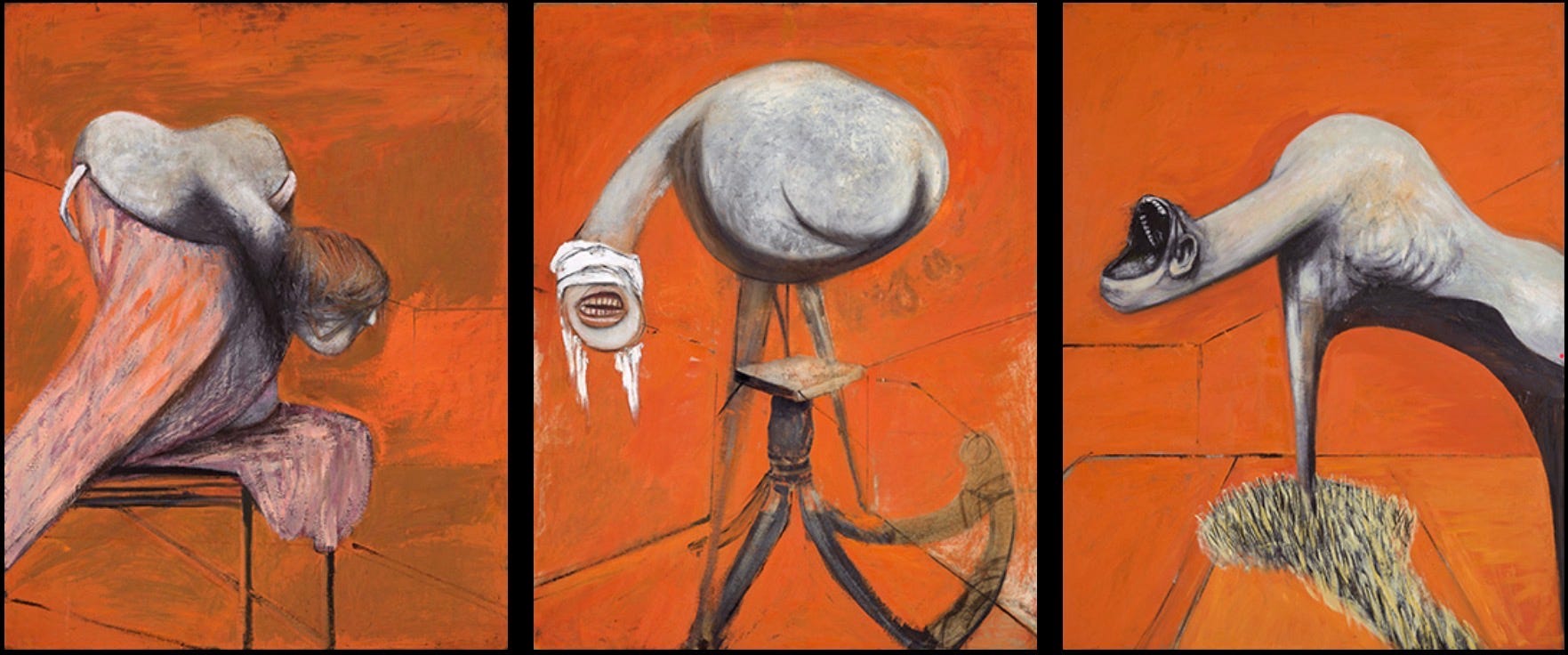
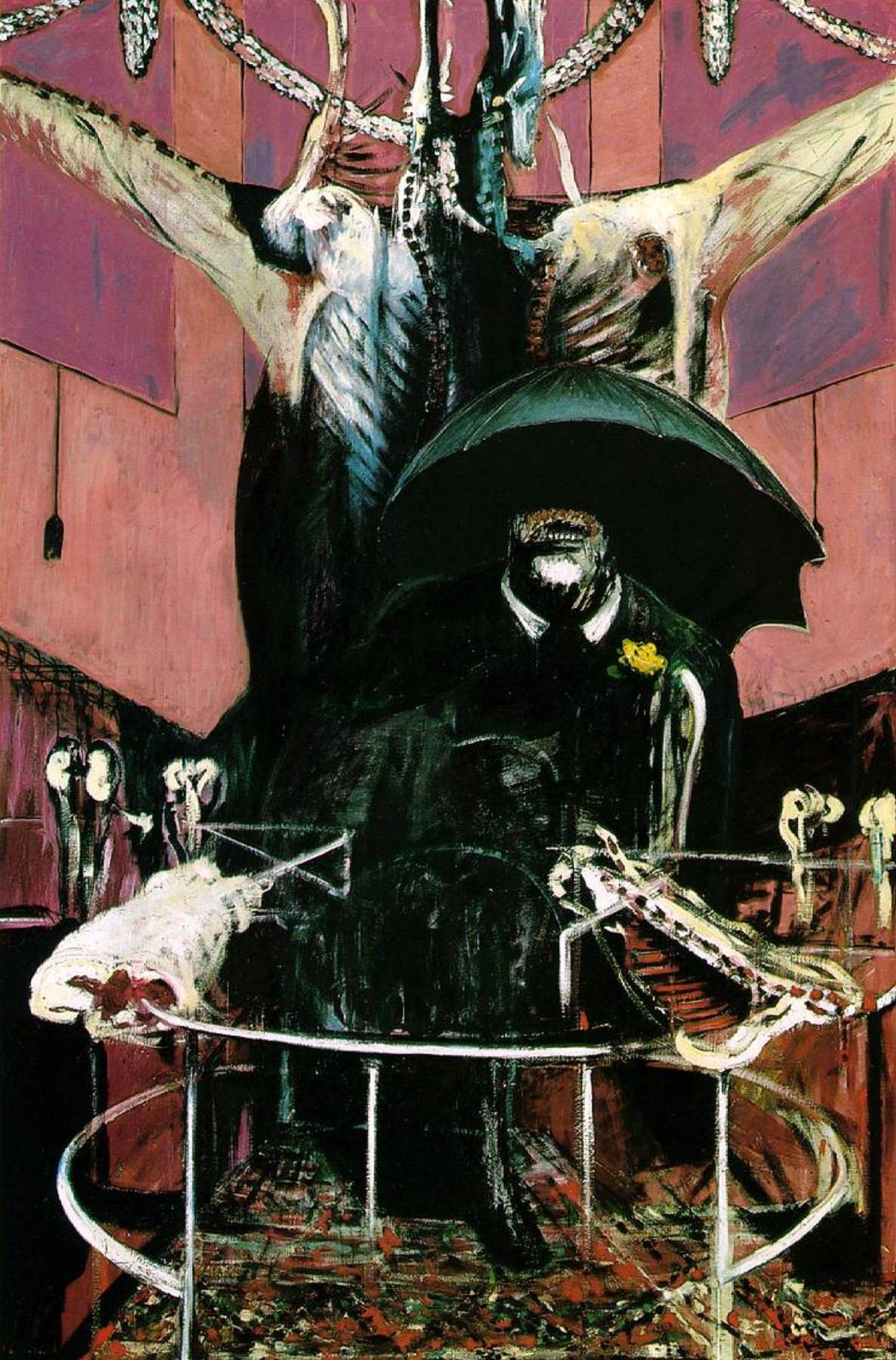
Bacon himself later treated this work as a point of no return, dismissing much of what he had made before it. What follows is a rapid intensification of method rather than a process of refinement. In the years immediately after, his handling of paint shifts from the linear severity of the triptych toward a more bodily in the paint itself, evident in works such as Painting (1946) and Head II (1949). At the same time, Bacon fixes on the human figure as his central subject, drawing repeatedly on photographic sources—most notably Muybridge’s studies of bodies in motion2—and beginning the obsessive reworking of Velázquez’s Portrait of Innocent X. From this point on, the body becomes the site where everything is tested, distorted, and forced into view.
III. The Cage, the Room, the Diagram
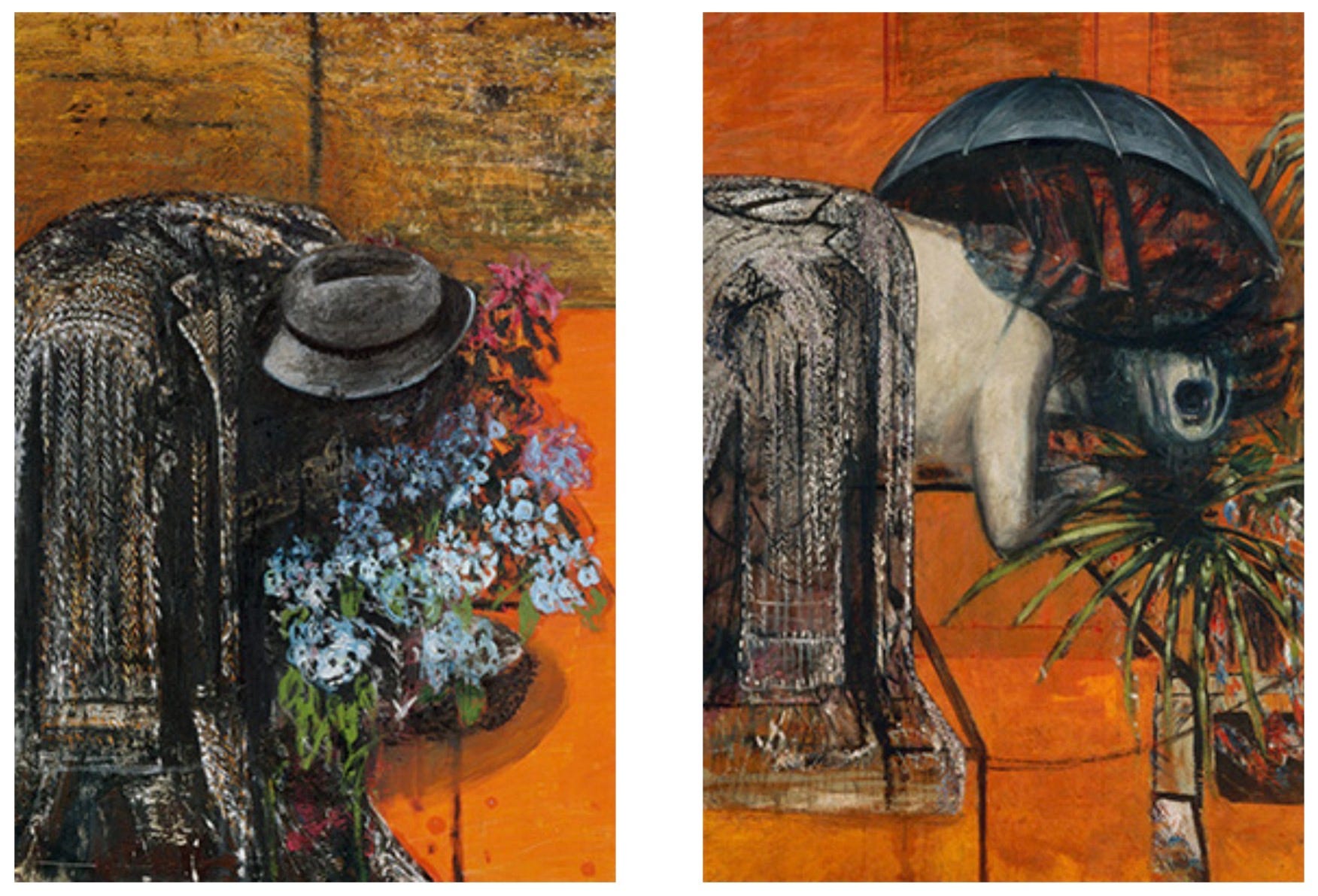
This is where Bacon becomes unmistakable. The language finds its footing. Figures appear already contained, pressed into shallow rooms and edged by transparent cages or architectural lines. Space asserts itself as force rather than background, tightening around the body and holding it in place. These structures function as diagrams: a means of thinking through what it means for a figure to exist under pressure.
The Screaming Pope series begins as “after Diego Velázquez,” but quickly moves beyond homage or quotation. The Papal portrait becomes a working template for a different question: what happens when paint treats a symbolic figure as flesh, light, and exposure rather than office. The scream marks the instant the role gives way. As an image, it unsettles confidence not by explaining anything, but by demanding duration.
In much of the scholarship shaped by Gilles Deleuze’s writing on Bacon, the scream is understood less as a psychological expression than as a pictorial event. It registers force rather than feeling, making something invisible felt through sensation.
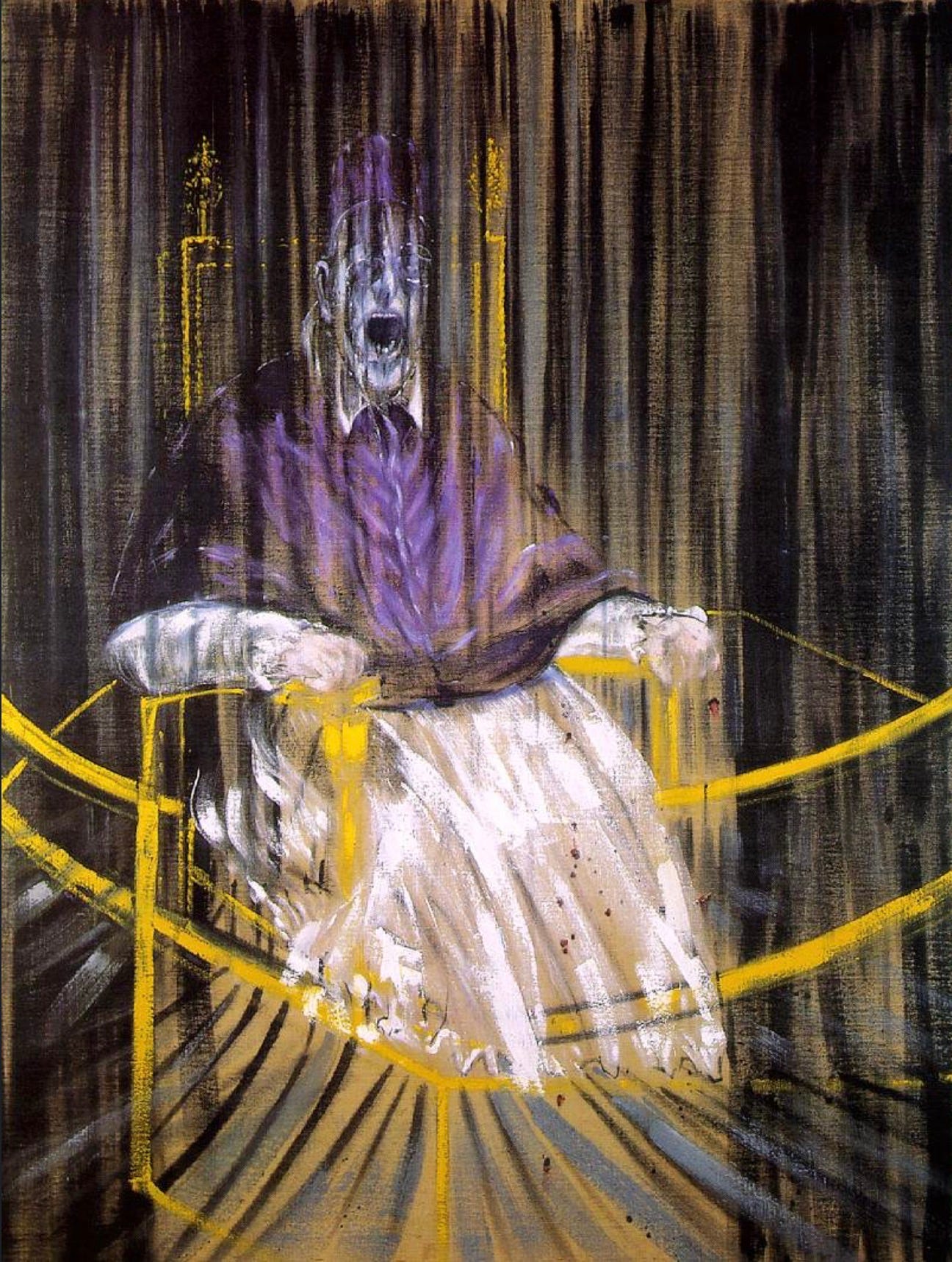
Bacon often said he wanted not an “illustration” of any reality but an image that concentrates it, a kind of shorthand of sensation. “Illustration,”3 in his circle, was almost an accusation: painting that stays obedient, readable, and explanatory. The scream, then, is not psychology made visible. It is painting refusing to become a readable caption for a feeling.
We will revisit this work in Part 3 of 4 for a visual analysis of what makes it feel so direct, without becoming illustrative.
The Man in Blue series marks a crucial consolidation in Bacon’s work. Here, the figure is no longer violently introduced into space, but already contained by it. The anonymous suited man appears repeatedly, seated or standing within shallow, angular interiors whose vertical lines press in from all sides. These are not portraits, but exercises in containment: the body held in place, subjected to a spatial logic that is calm, controlled, and quietly oppressive.
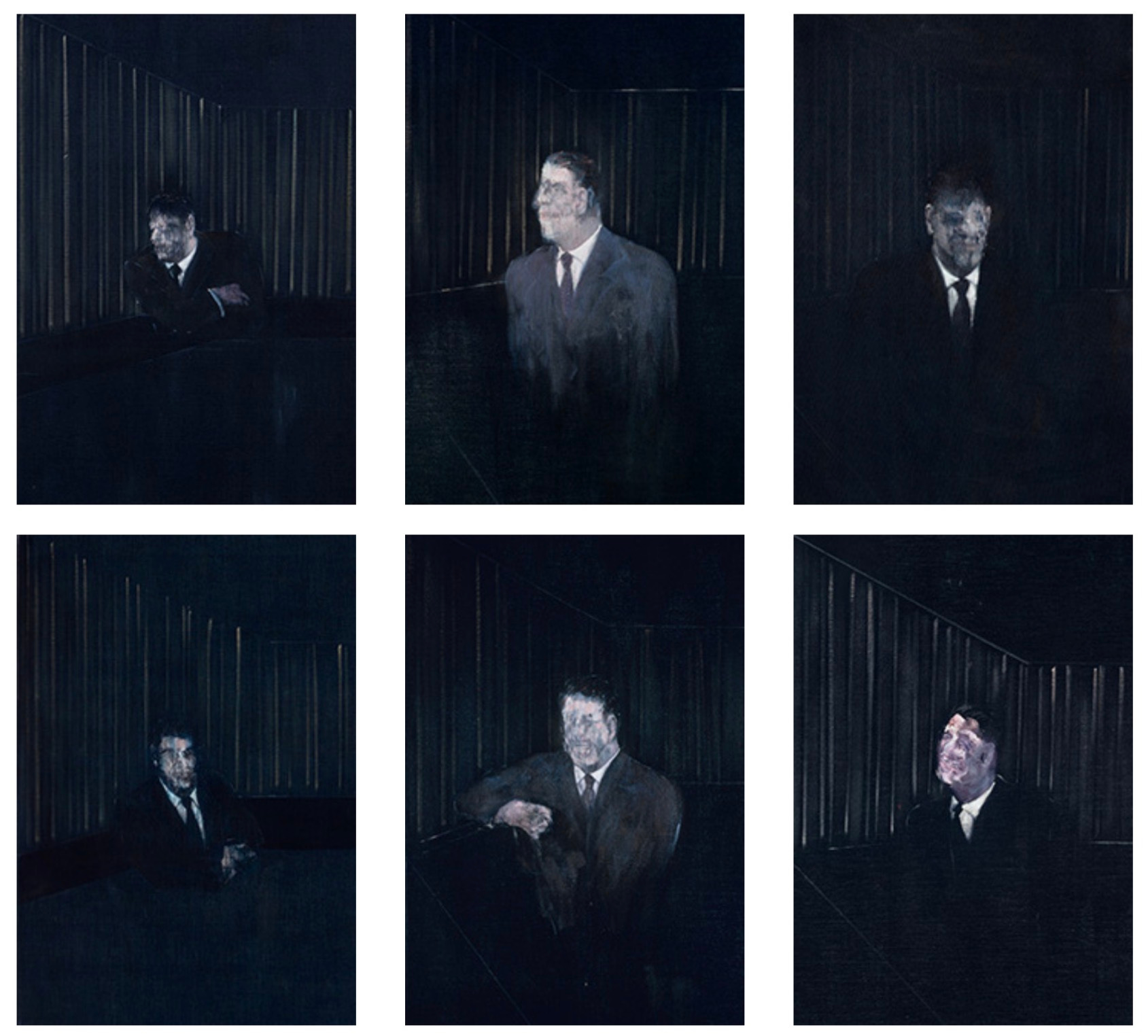
Structure takes precedence here, and expression is pushed to the margins. The repeated figure allows Bacon to test how much variation the image can bear without breaking its underlying framework. Small shifts in posture, facial distortion, or tonal weight register as disturbances within an otherwise stable system. The room functions as a diagram rather than a setting, and repetition becomes a way of thinking rather than narrating. In these works, Bacon’s language of enclosure, isolation, and pressure is no longer tentative. It has found a form capable of sustaining repetition.
IV. Triptych thinking and repetition—time without story
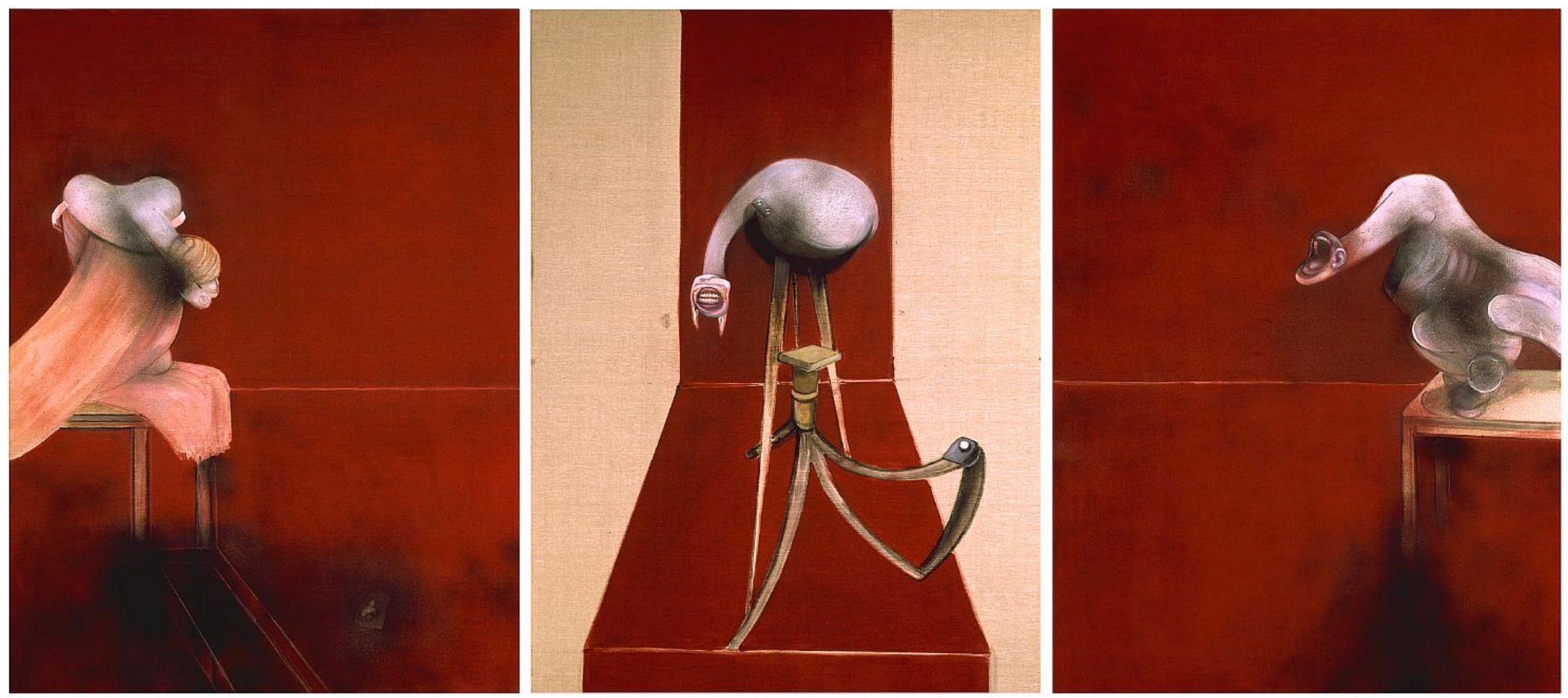
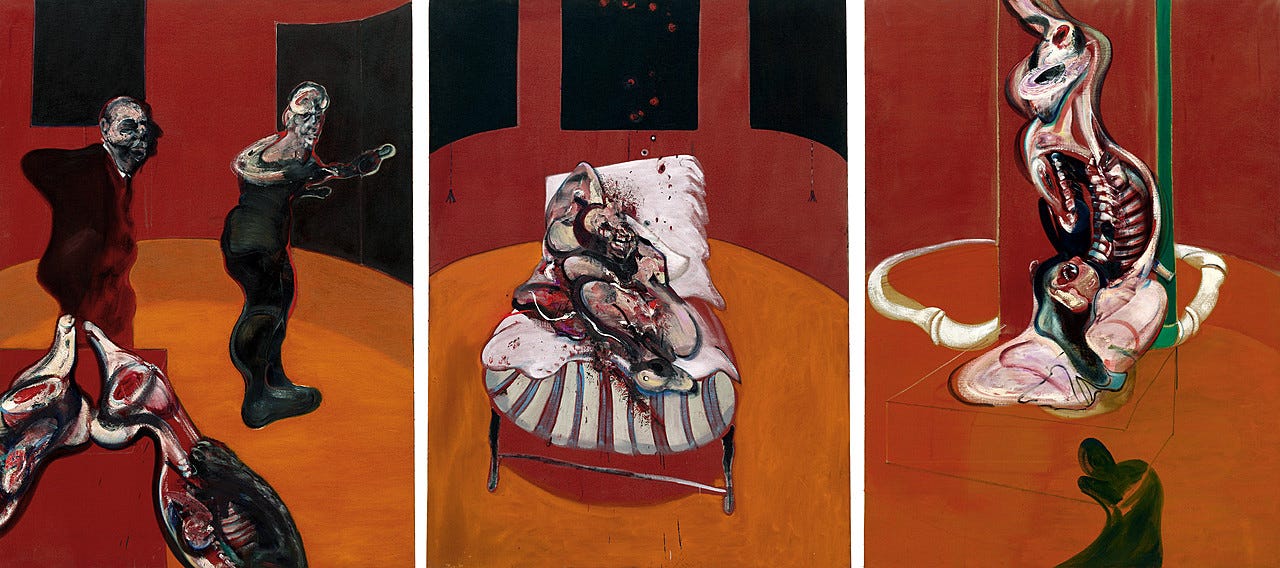
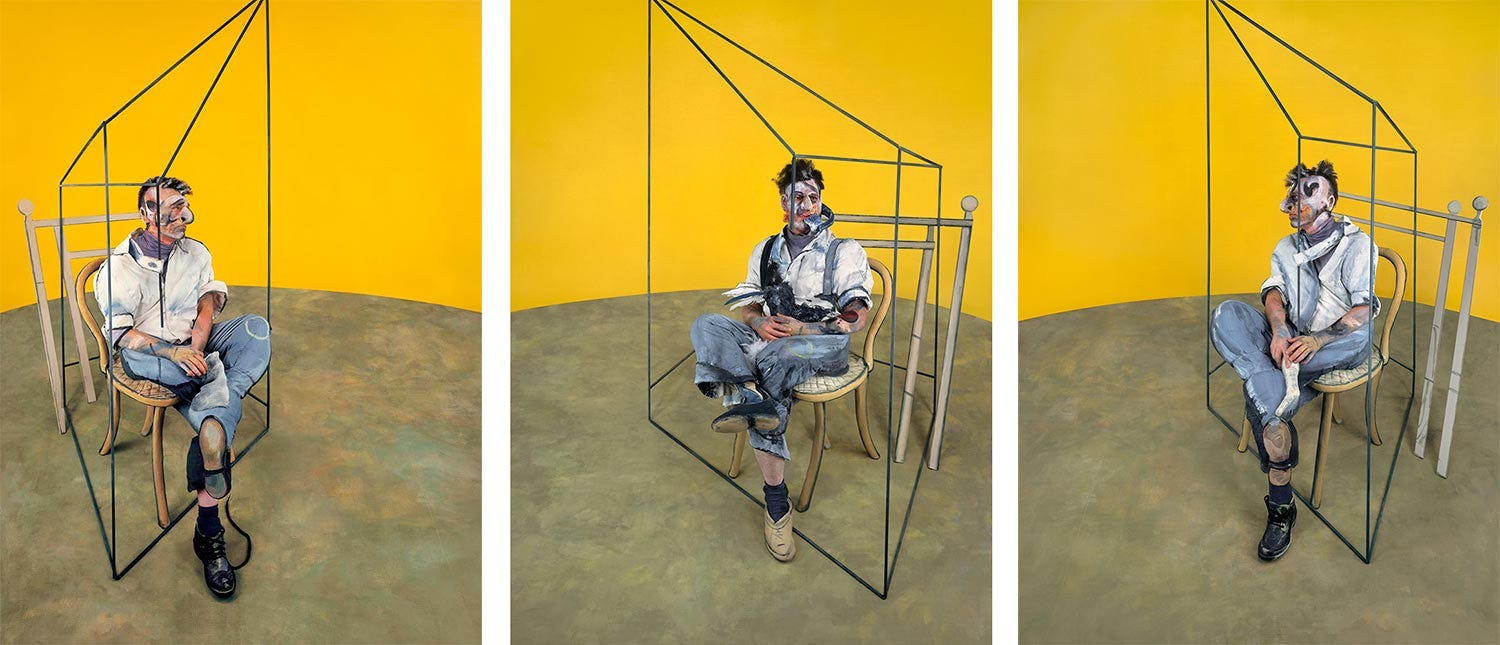
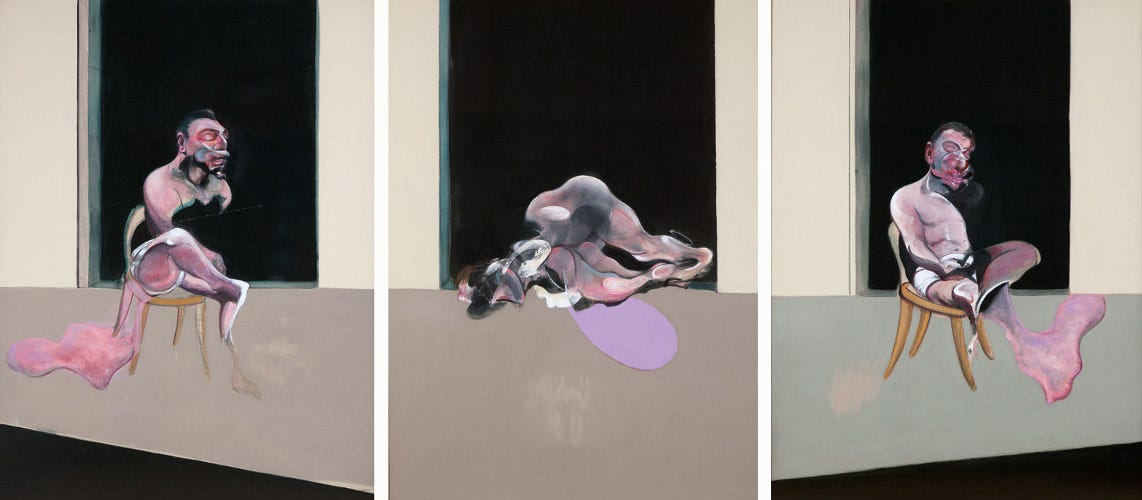
From the late 1940s onward, Bacon increasingly began to work in triptych form, returning to it again and again over the following decades. These three-panel works became one of the most recognisable structures of his practice, used across different subjects and periods rather than reserved for a single motif. Rather than treating the triptych as an occasional format, Bacon made it a sustained way of working, producing numerous variations within the same compositional frame. This body of work now stands at the centre of how his painting is understood. In the next post, I’ll turn to the triptychs themselves, looking more closely at what drew Bacon to this structure and how it shaped the direction of his work.
V. Late Bacon: thinning, exhaustion, aftermath
In the later works, Bacon’s vocabulary begins to loosen. Backgrounds empty out, figures fragment, and the earlier sense of containment weakens. Violence is still present, but quieter, less emphatic, as if even intensity has been exhausted. The paintings do not conclude so much as taper off, leaving the body suspended in a diminished, uncertain space.
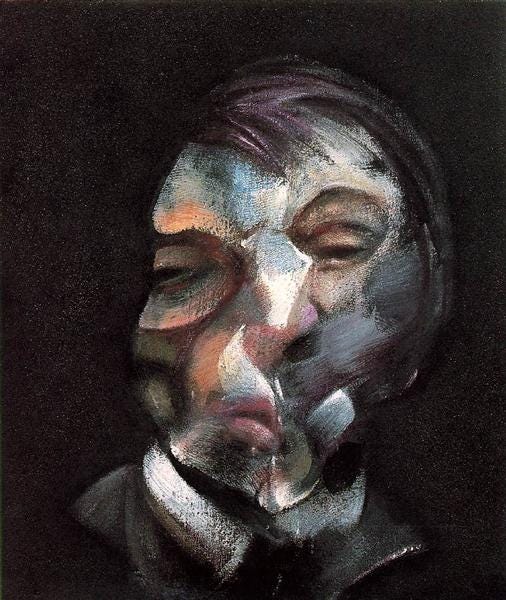
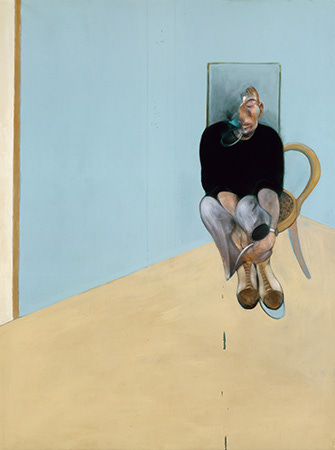
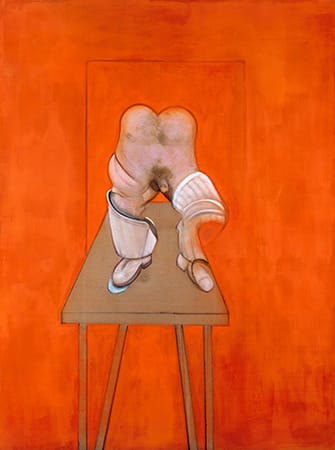
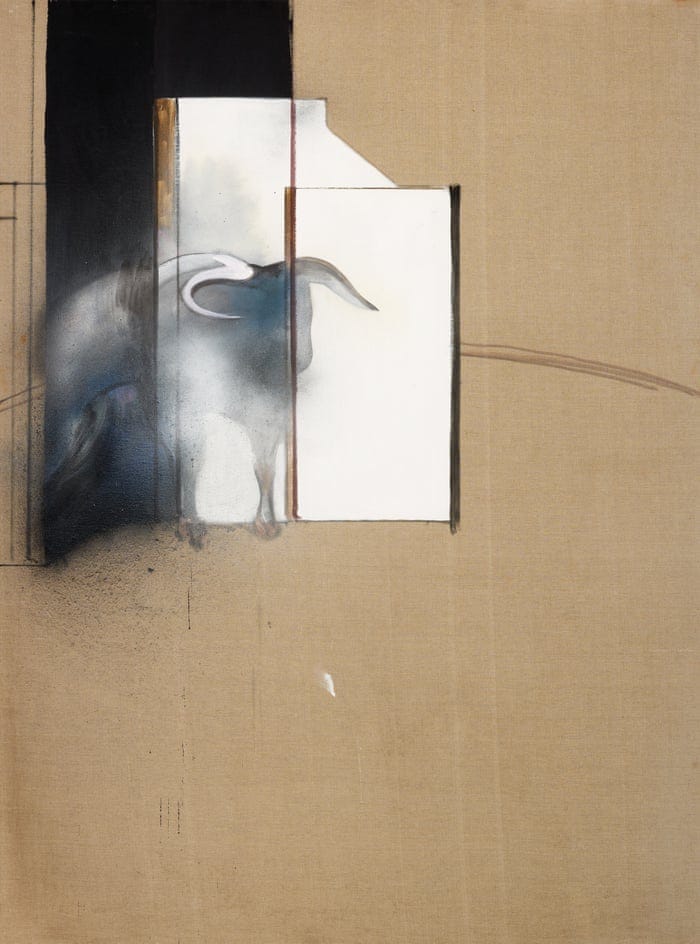
In Study of a Bull (1991), Bacon returns to a motif he never turned into a statement. The figure is no longer locked into a room or caught by a frame. It stands against an open dark ground, reduced to weight, movement, and the blunt fact of presence. The violence recedes from spectacle without becoming gentler.
What arrests me is the economy. So many of the devices you’ve watched him develop, enclosure, distortion, pressure, are still there, but in a thinned register, as if the language has been left out overnight and dried at the edges. The image does not explain itself. It simply stays. And that staying changes how we look back at everything that came before.

This gallery offers an orientation rather than a closure. In the next post, we will slow this movement down further by returning to a single painting format, reading it closely as a way of understanding how Bacon’s language operates from the inside.
Over the coming month, the focus will shift and narrow:
a sustained return to a single, canonical triptych, staying with the theme Bacon circled most obsessively
a close visual analysis of the screaming Pope, read image by image
an immersion in Bacon’s world of books and influences, tracing how reading shaped his pictorial thinking, bringing the sequence to a close
For now, let’s remain here. Let us sit with these images. Let one painting hold us longer than expected. My hope is to slow the looking just enough that we begin to notice what draws us in. Which image in this gallery held you the longest—or resisted you—and what do you think did the holding? ♦

The Eumenides, the final play in Aeschylus’ Oresteiatrilogy (458 BCE), resolves the cycle of blood vengeance by establishing the first Athenian law court (the Areopagus). The Furies, or Erinyes, pursue Orestes for matricide; under Athena’s guidance, he is acquitted via a trial by jury, transforming the avengers into the “Eumenides” (Gracious Ones).
Eadweard Muybridge (1830–1904) was a pioneering 19th-century photographer renowned for his groundbreaking studies of human and animal motion, which bridged the gap between scientific investigation and artistic representation. His work, most notably Animal Locomotion (1887), fundamentally changed the understanding of movement by capturing phases of motion too fast for the human eye to see.
“Illustration” (Bacon’s term of contempt). In Francis Bacon’s own talk, “illustration” does not mean book illustration. It is a value judgment about what a painting is doing. Bacon repeatedly distinguishes between an image that functions as a mere depiction or report, and an image that operates as a direct pictorial fact. In interview contexts he describes his aim as making “not an illustration of reality” rather “images which are a concentration of reality, and a shorthand of sensation.”
What makes something “illustrative” in this sense is not subject matter but mode:
• Too explanatory: the painting behaves like evidence for an idea, a story, or an emotion. It becomes legible before it becomes felt.
• Too dependent on reference: it leans on the photograph, anecdote, or narrative it began from, rather than transforming that starting-point into an autonomous pictorial event. (Bacon is especially hostile to “narrative” in this illustrative sense.)
• Too compliant with “visual fact”: it settles into description, where the camera could do the job better, and the painting merely supplies style. Bacon frames the alternative as sensation, presence, and nervous-system impact.
This is also why “illustration” could function as an insult inside the postwar London figurative milieu, including in the orbit of Lucian Freud: it named the failure to make painting do something only painting can do. Bacon’s well-known ruthlessness about destroying canvases belongs here. When he felt a work had collapsed into something too legible, too explained, too near to “mere illustration,” he preferred to eliminate it rather than let it stand as a compromised statement.
I’ve been looking at these repeatedly, and I keep circling two things. Whether the cage in these paintings is a structure we see, or one we begin to feel after standing there for a while.
And whether the scream is really the most important thing here, or if the stillness is doing more work than we tend to admit.
Thank you for this article. I had not even been consciously aware of the artist, previously knowing Francis Bacon only as the philosopher and statesman. As a teen I appreciated the work of Giacometti at MoMA in NYC. Is Bacon exhibited there as well? The art is disturbing, to me, but I can't stop looking at your photos.