


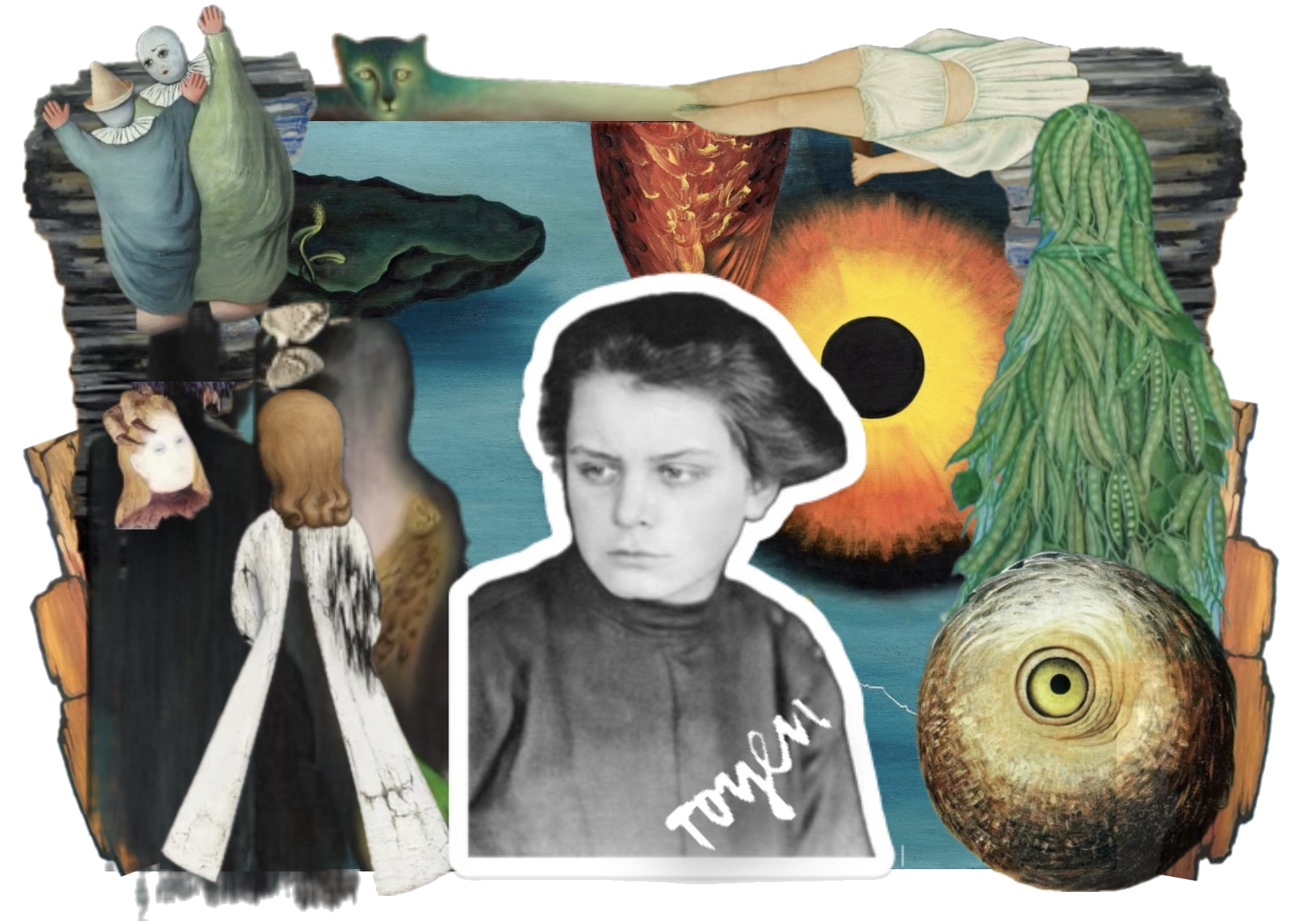
Toyen was born Marie Čermínová in Prague in 1902. She outlived two world wars, a Nazi occupation during which she hid a Jewish poet in her apartment for three years, a Communist takeover that ended her life in Czechoslovakia for good. She died in Paris in 1980 having barely given an interview, having destroyed as much of her own work as she preserved, and having watched the city she chose change three times around her.
But this is not where we begin and none of that is what this post is really about.
What this post is about is fifty years of painting: what the work looked like when she was twenty-three and making something she and Jindřich Štyrský1 called Artificialism,2 and what it looked like when she was seventy and still at it in Paris. The arc between those two points is not a smooth development. It breaks, it goes underground, it surfaces in forms that seem to belong to different artists entirely, until you look long enough and realize they don’t.
That is what we are going to look at this month.
The Early Period of 1919–1929
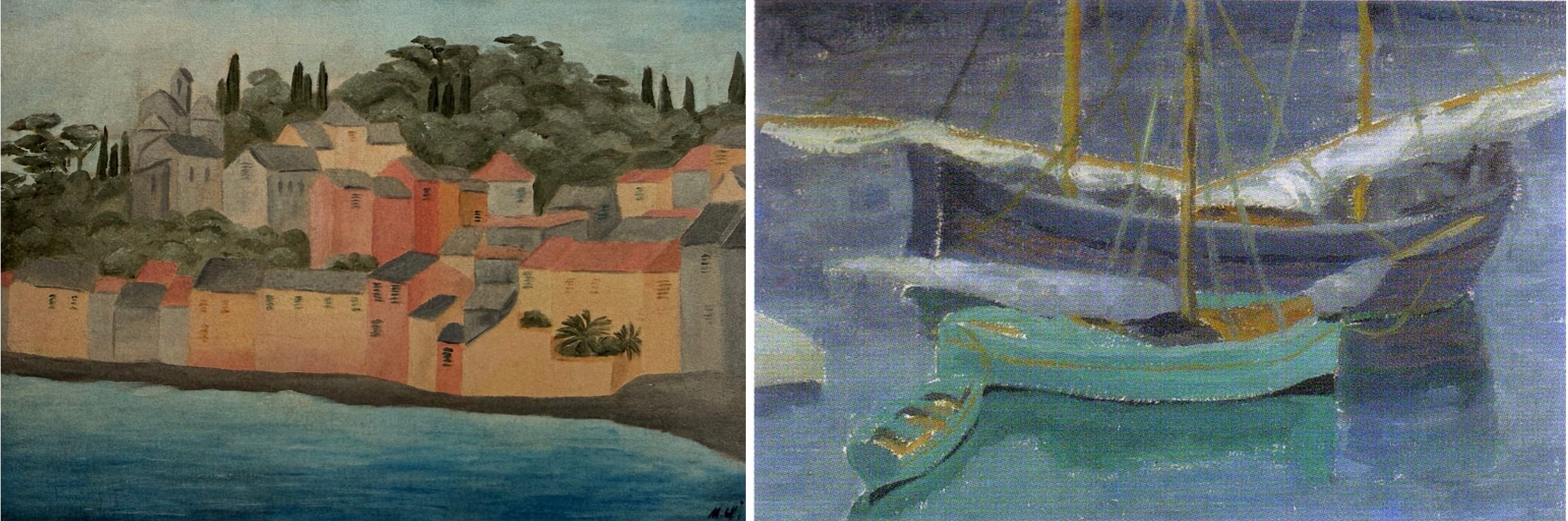
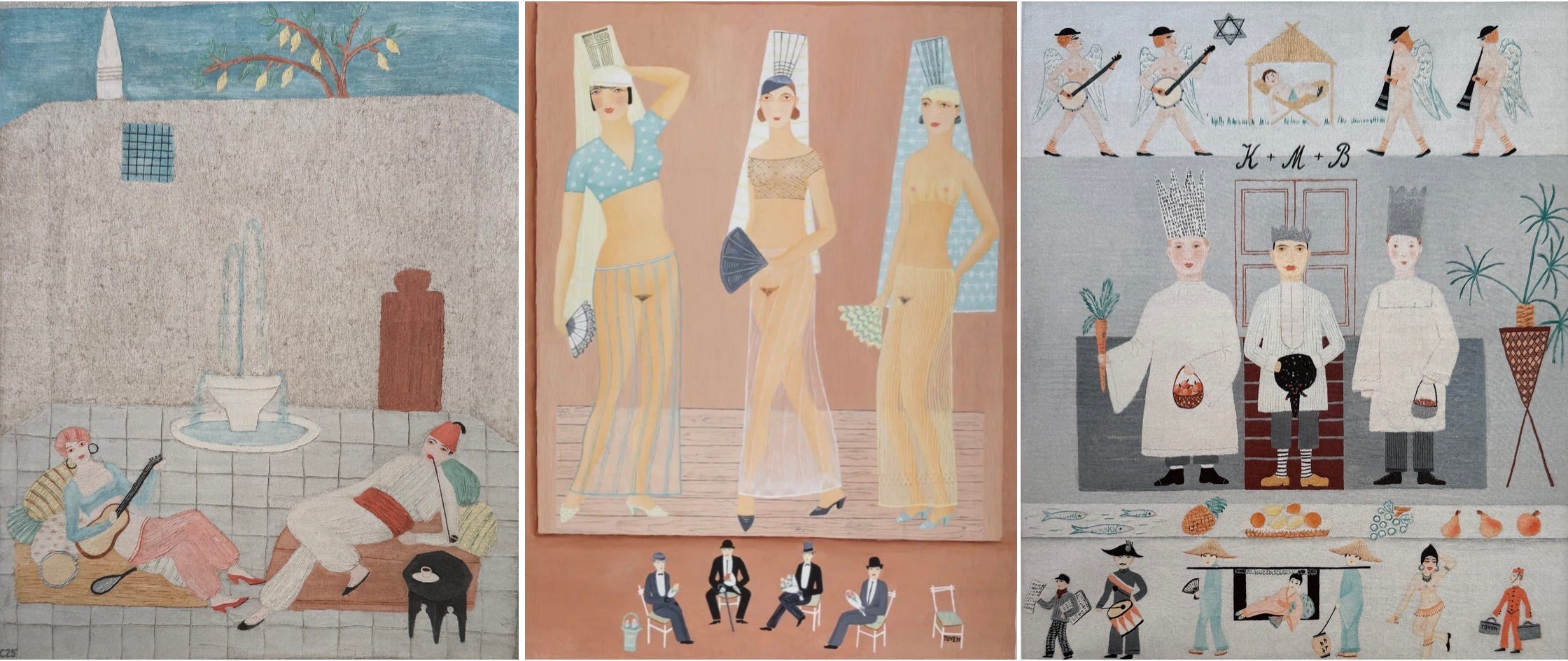
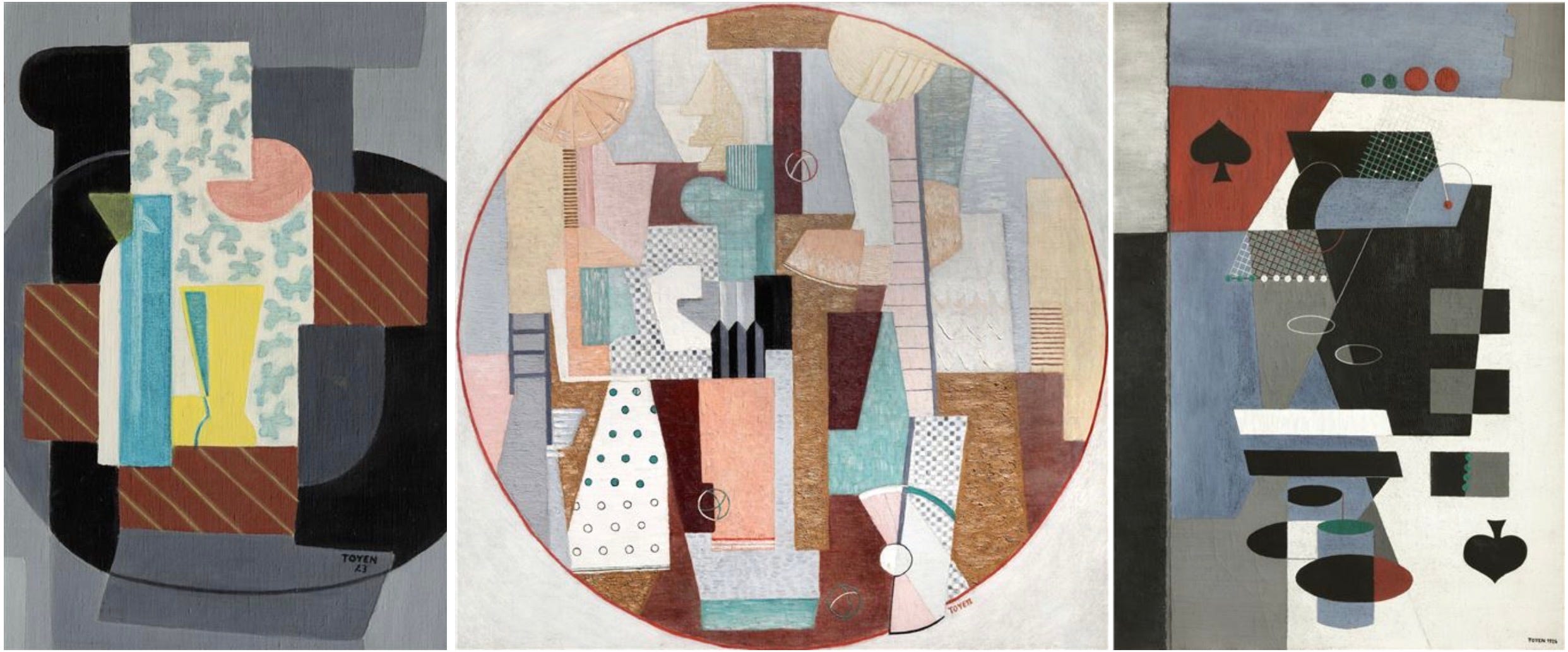
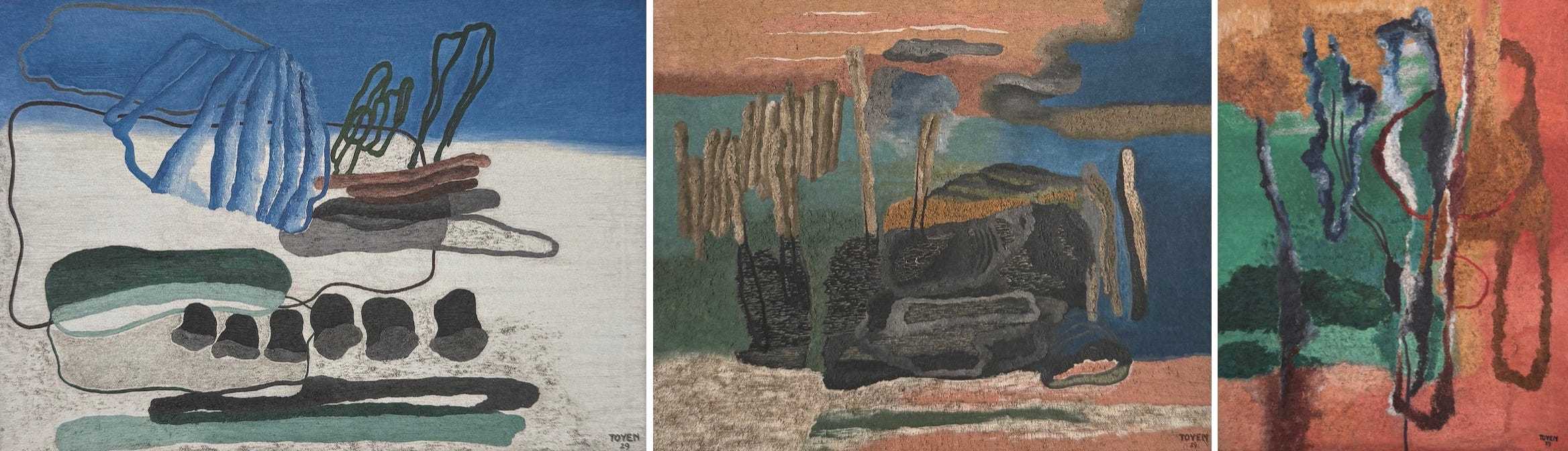
Toyen’s early work moved from Cubism through a brief engagement with naïve art, before a more decisive break arrived just before her first Paris stay. In 1925, she passed through a short but striking “primitivist” phase,3 already testing the limits of acceptable subject matter, and then, in Paris with Štyrský, the two developed what they would call Artificialism. It rejected painting as formal play for the eyes, and it rejected what it called the “formally historicizing painting” of Surrealism. What they proposed instead was a different relationship between image and sensation. Technically, this meant dripping or spray-painting through grids, stencils and various objects, or building up thick and tactile layered surfaces in order to foreground the material properties of paint itself. In their two manifestos of 1927 and 1928 they wrote of melding painterly form with poetic sensibility, claiming:
“We have no memories, but we are trying to manufacture them.”
The Artificialist paintings that resulted are non-mimetic, imaginary landscapes, not abstraction in the Constructivist sense, but something stranger; they are images built from the texture of remembered feeling. By 1929, back in Prague, Toyen had already begun experimenting with a new language of psychological association, the turn that would carry her into full Surrealism.
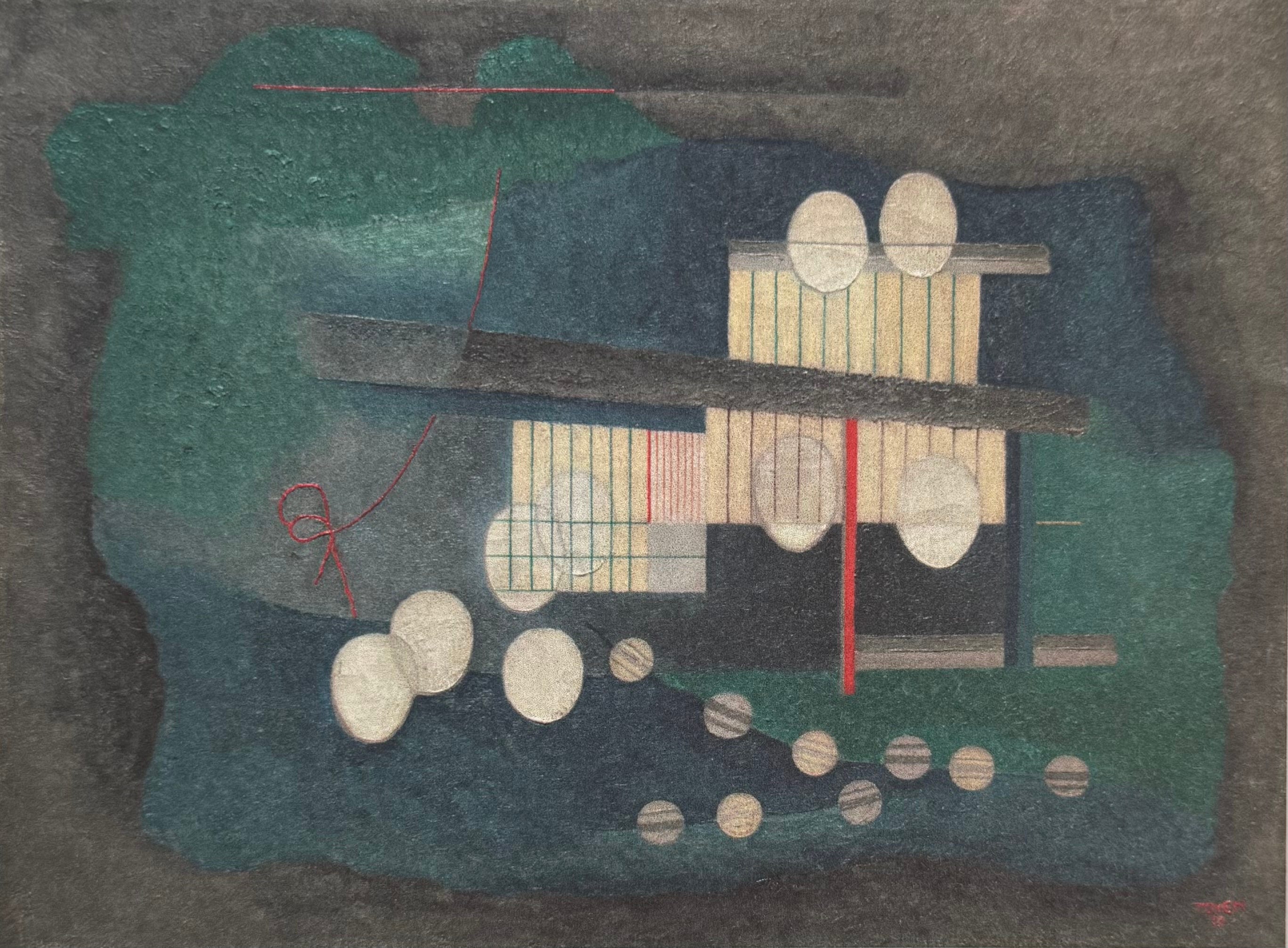
Chinese Tea Shop is one of Toyen’s most quietly unsettling Artificialist works and my personal favorite from her early period. The texture alone is captivating, paint built up and scraped back in ways that give the surface an almost geological presence. But what makes the composition genuinely uncanny is the spatial logic: the shop materialises out of a dense green ground like an apparition, neither fully embedded in its setting nor detached from it, hovering at the threshold between the discovered and the imagined. There is something here that for me recalls Miyazaki’s darker films, where the domestic and the otherworldly occupy the same frame, or the unnamed shops that appear in Murakami’s After Dark, places that seem to exist slightly outside ordinary time. Toyen was working here at the height of Artificialism, making images from the remembered sensation rather than observed form; a scene so specific it feels real, and so displaced it feels like a dream.
Stepping Towards Surrealism 1930–1938
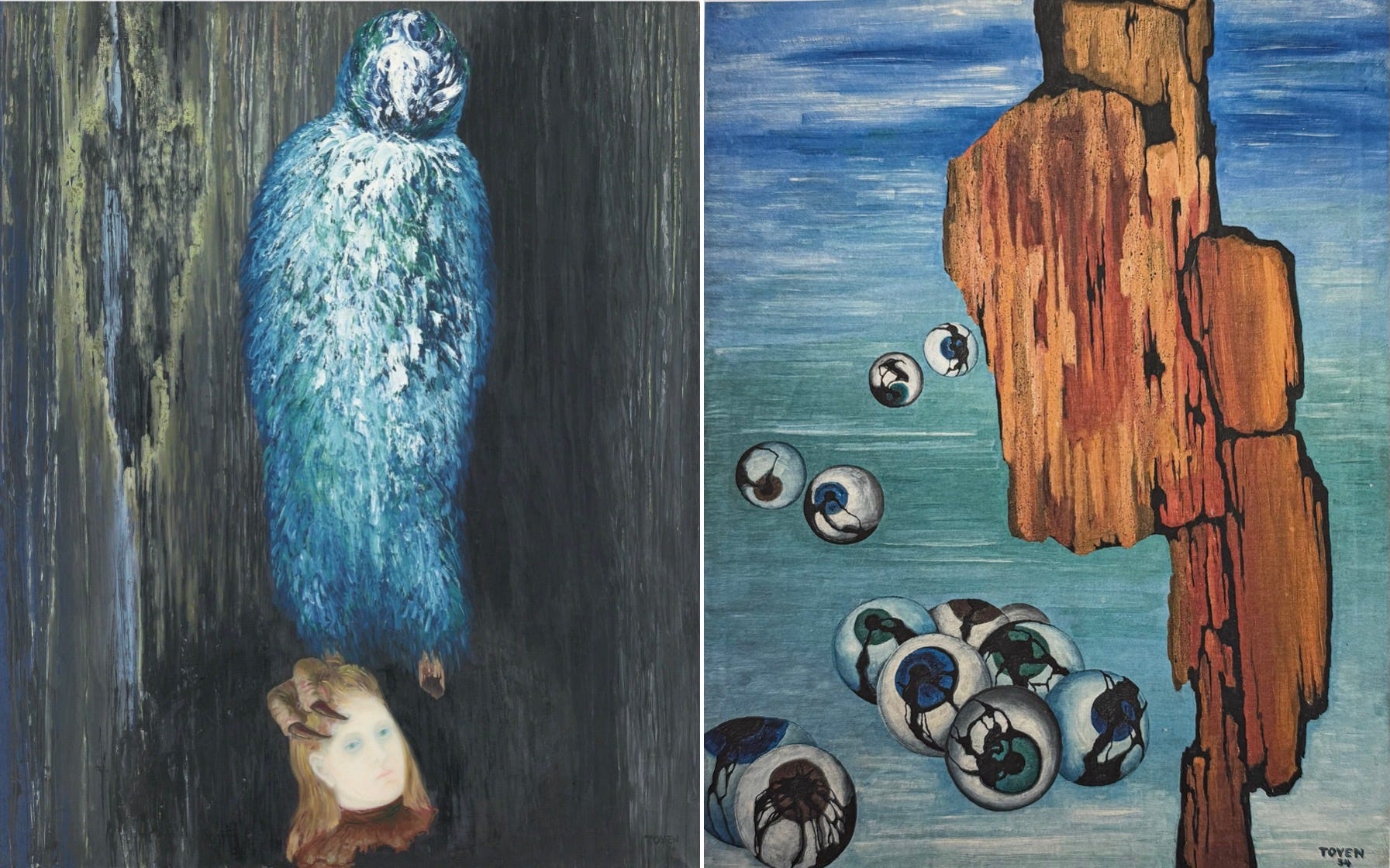
The 1930s brought a shift: where the Artificialist Toyen had favored flatness, she now began painting more conventionally three-dimensional forms, rendering them at once vivid and hard to identify. She was evolving toward a personally defined iconography oscillating between reality and imagination, the seductive and the abyss. The transition was not a clean break but a deepening. Artificialism’s interest in manufactured memory was being pulled toward something more visceral. Throughout the 1930s, she produced works combining eroded surfaces suggesting dreams and visions with numerous hints of eroticism.
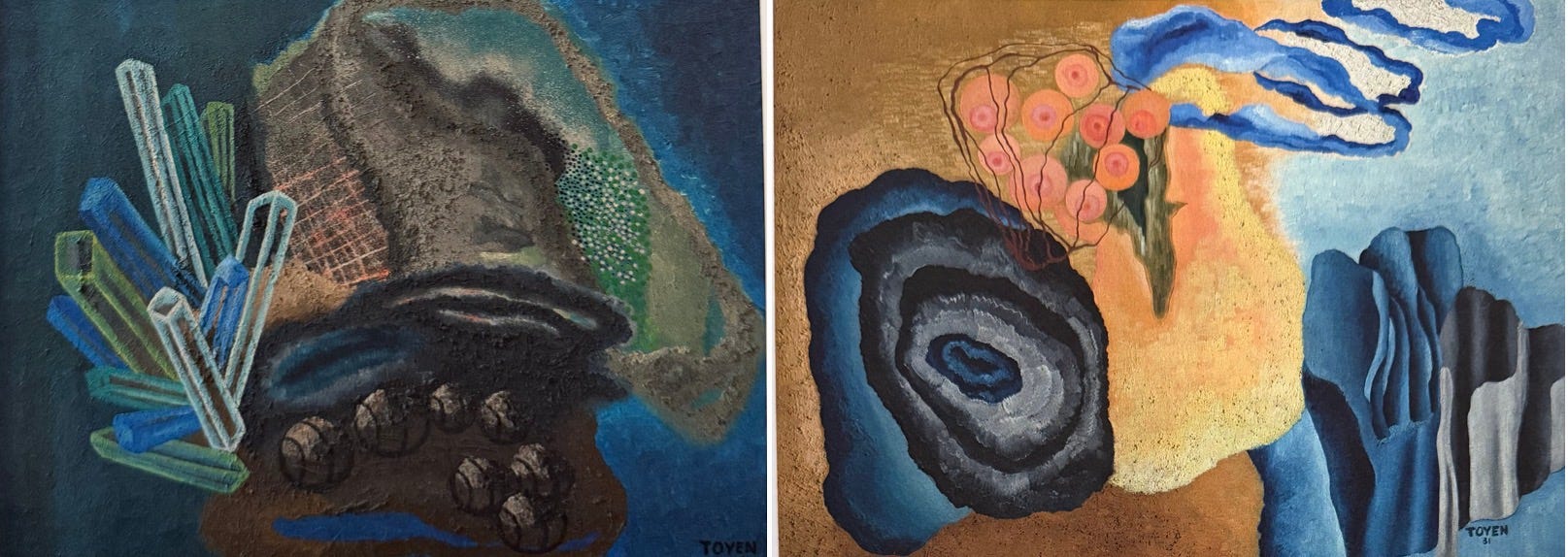
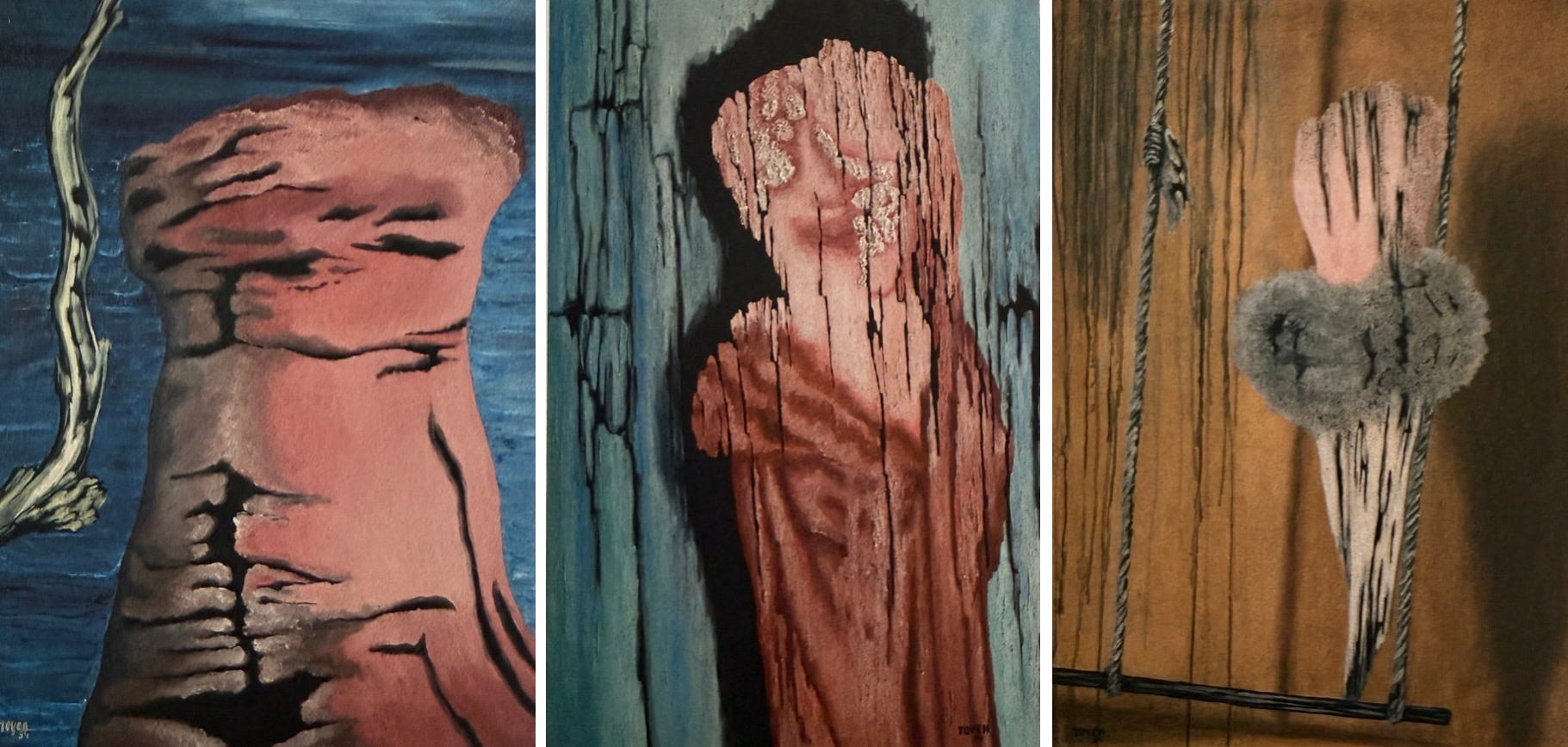
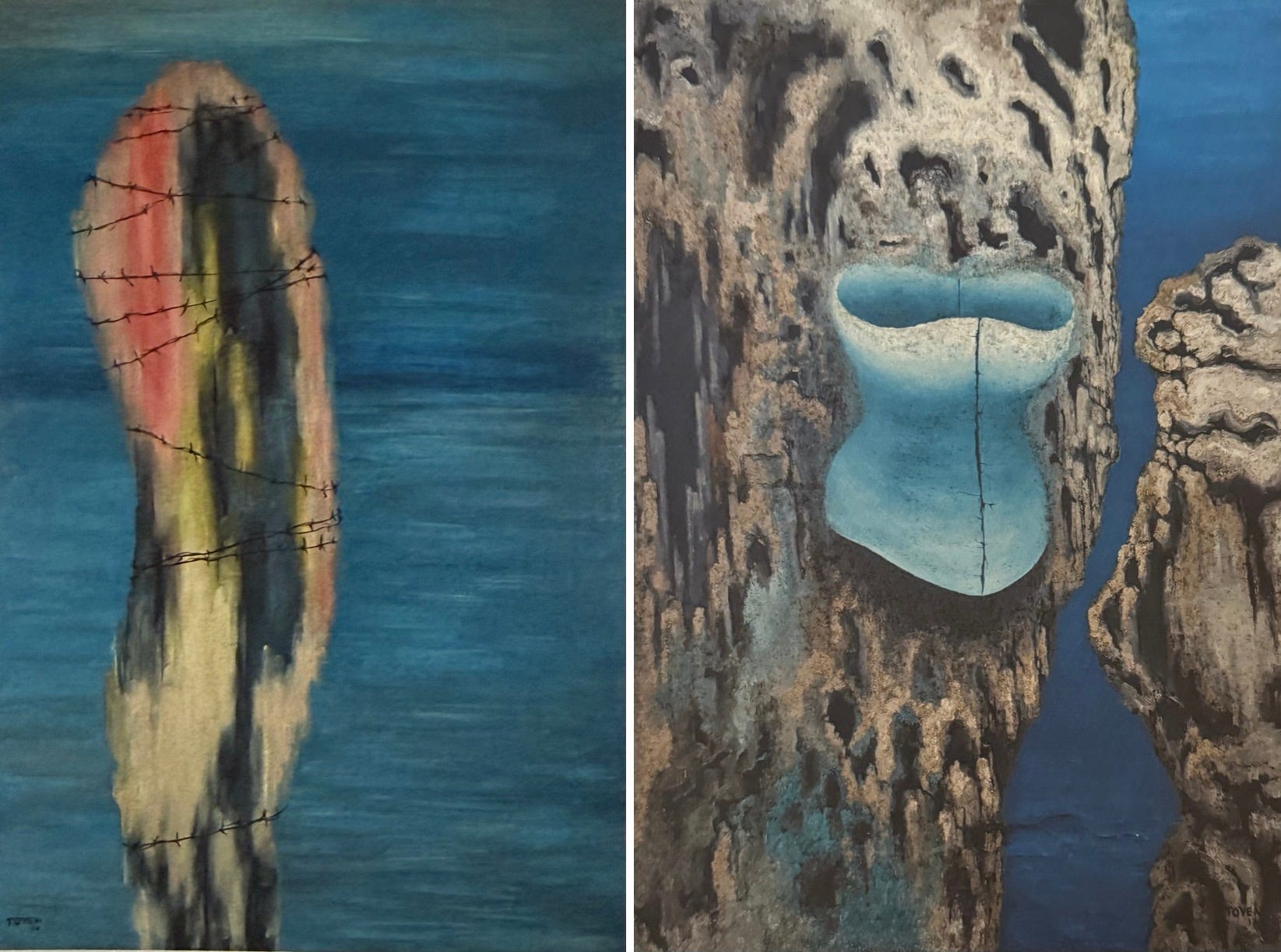
Two paintings anchor this period. In Prometheus, a huddled wire-wrapped entity raises the question of whether you are looking at an empty garment or an outcropping of stone -- an impossible-to-complete zone. In the Abandoned Burrow, the sexual content is suggested rather than explicit: the strident corset shocks because of its alienation and specificity, seeming to intrude into the natural world as a signifier of forms that are both present and absent. Whitney Chadwick, one of the earliest Anglophone scholars to write seriously on Toyen, identified this quality of hovering menace as central to her Surrealist work.
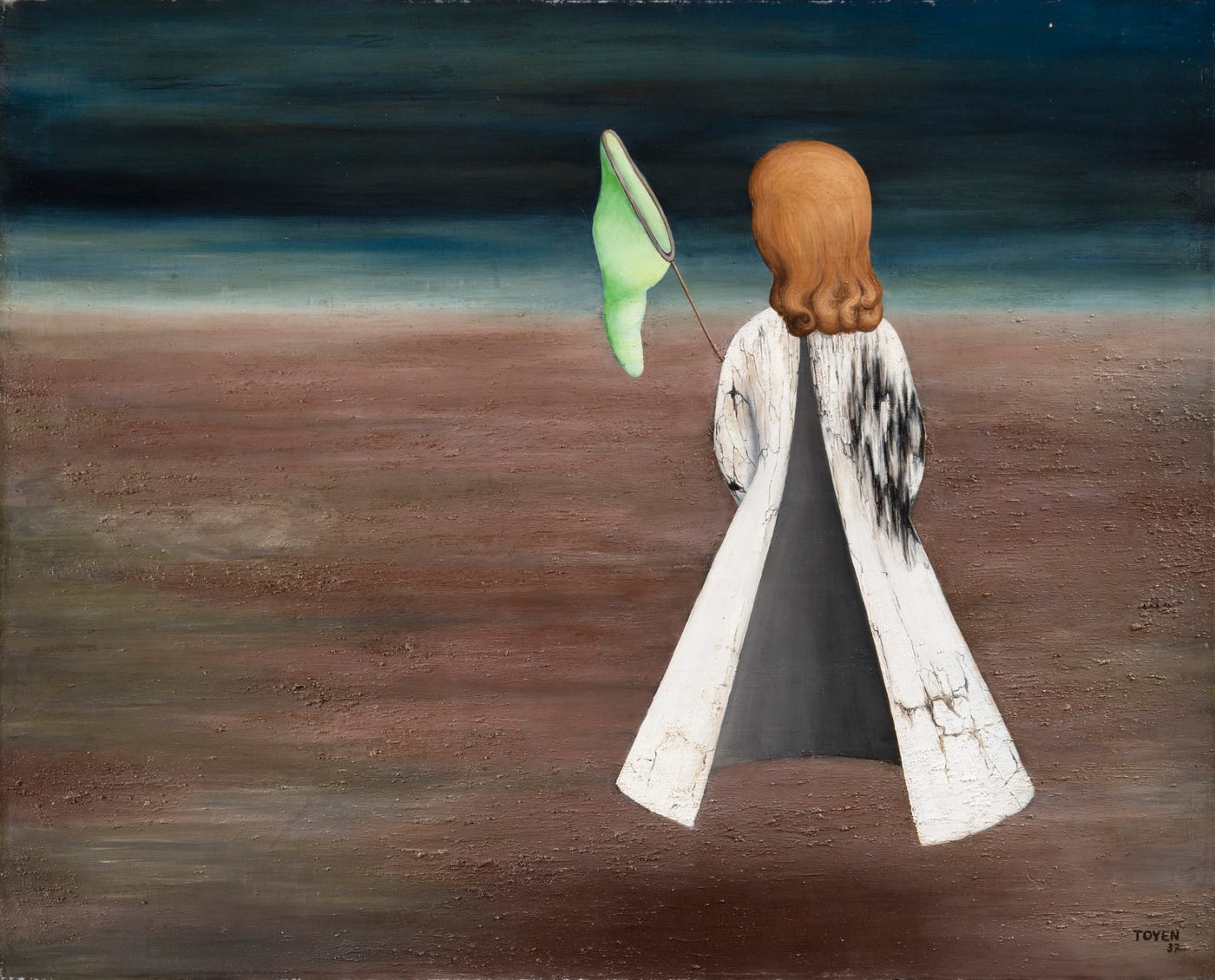
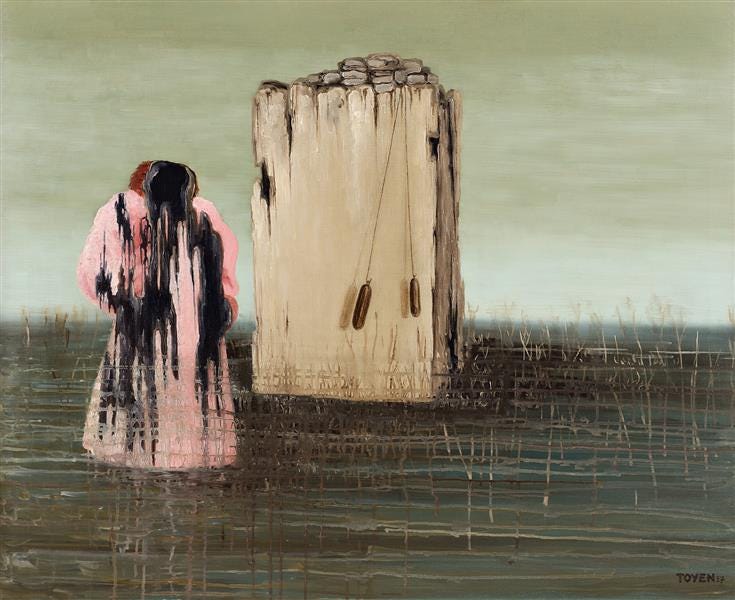
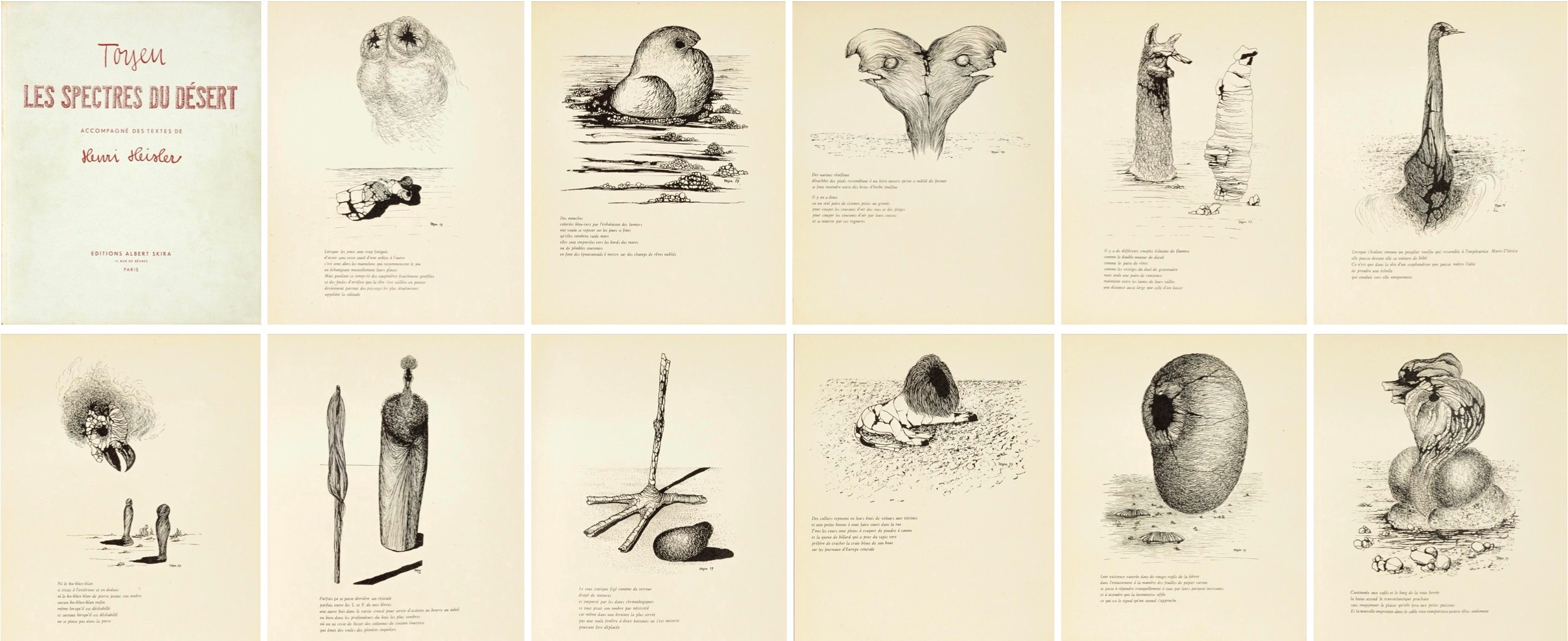
Toyen was a founding member of the Czechoslovak Surrealist Group in 1934, and helped organize its first exhibition the following year. Czech Surrealism, strongly influenced by the Poeticist strand of Devětsil,4 remained distinctively linked to literary sensibility. From the mid-1930s, her work with matter began registering an oncoming catastrophe (premonitory in character) visible in the two drawing series The Spectres of the Desert (1936–37) and the work that would follow. The formal freedom she had claimed through Artificialism was now being turned toward darker ends.
The War Years 1939–1946
In 1939, Toyen’s name appeared on a list of artists banned from public activity in occupied Czechoslovakia, now the Protectorate of Bohemia and Moravia. She continued to work in secret. Together with the poet Jindřich Heisler, whom she sheltered throughout the war, she produced some of Surrealism’s most iconic works, visual acts of resistance shaped by the trauma of occupation and the urgency of concealment.
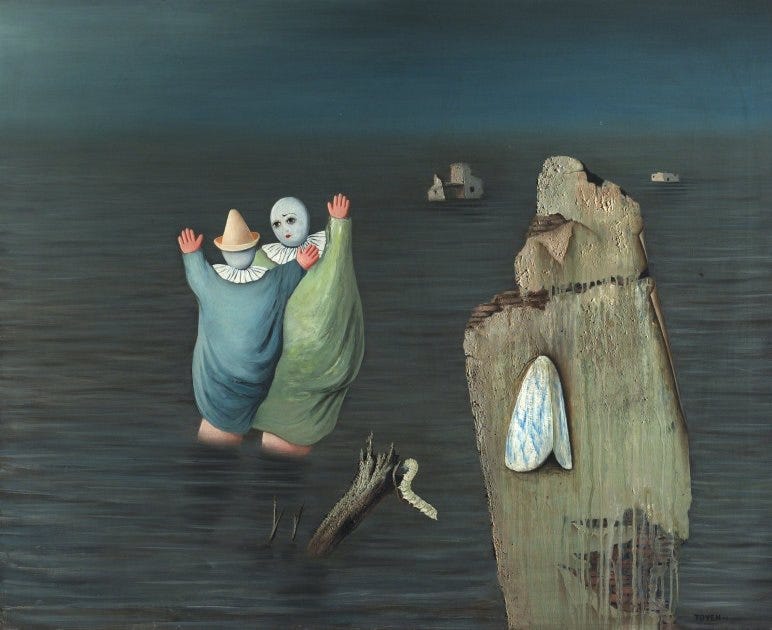
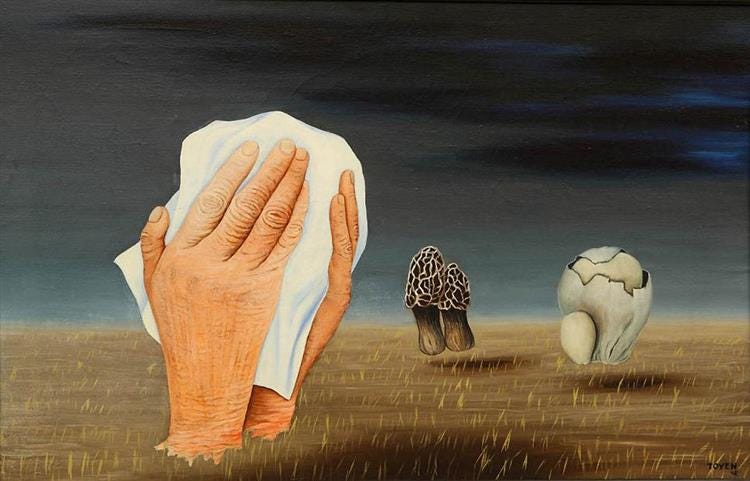
The first of the wartime drawing series was The Shooting Gallery (Střelnice, 1939–40). The title carries a deliberate duality: it refers both to a shooting range used for military training and to a popular carnival attraction for children. It is precisely this collision of violence and childhood that shapes the haunting landscapes of the series. Toy blocks, marbles, dolls, puppet theaters, a jump rope, a schoolbag, letters from a children’s primer, these are juxtaposed with ghostly and disintegrating bodies in a barren environment that suggests the fragility of life. From within the same period come paintings including Potato Theatre, Sad Day, and Between the Long Shadows, works in which Toyen moved away from Artificialist flatness toward more three-dimensional forms, vivid but impossible to fully identify.
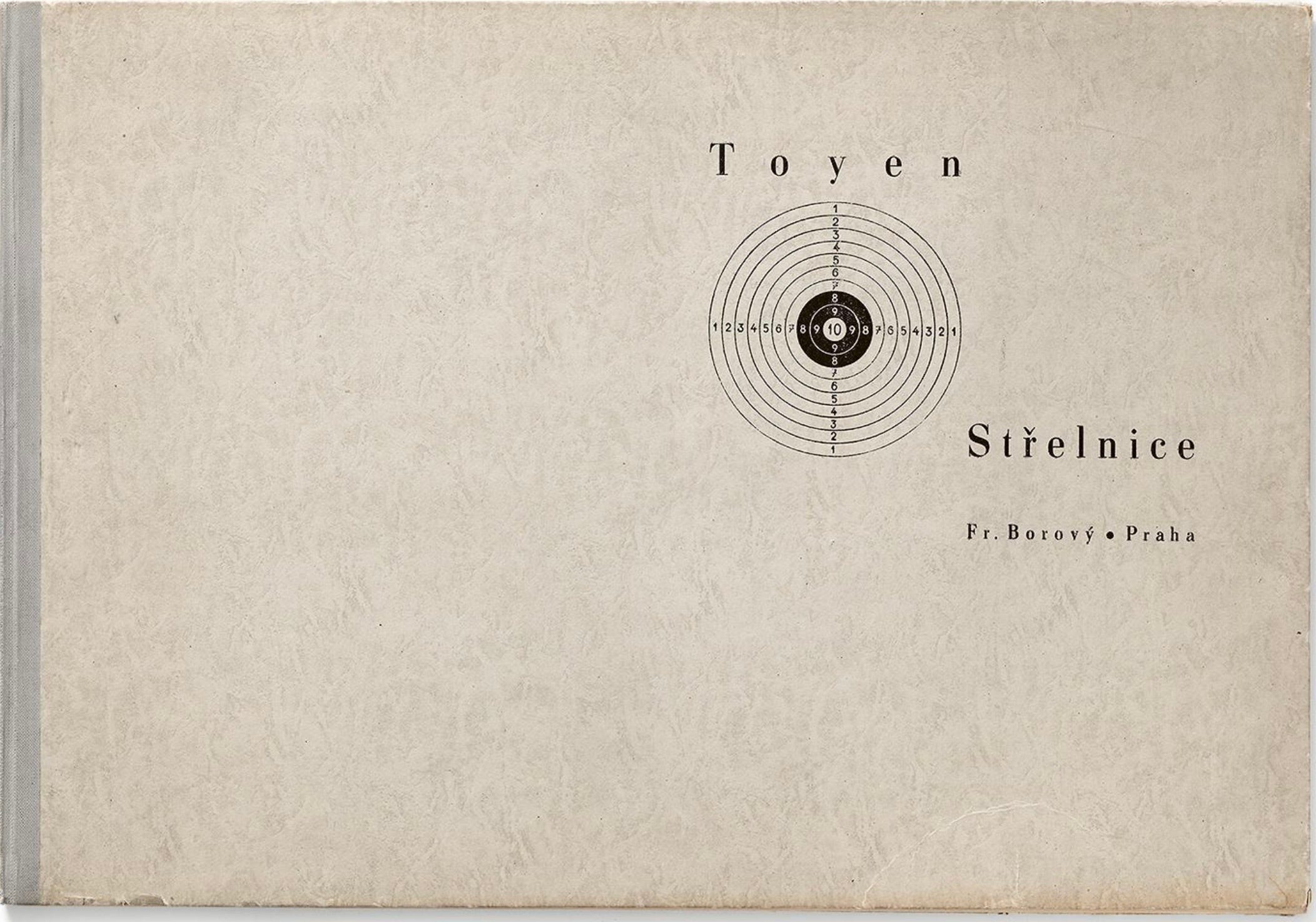
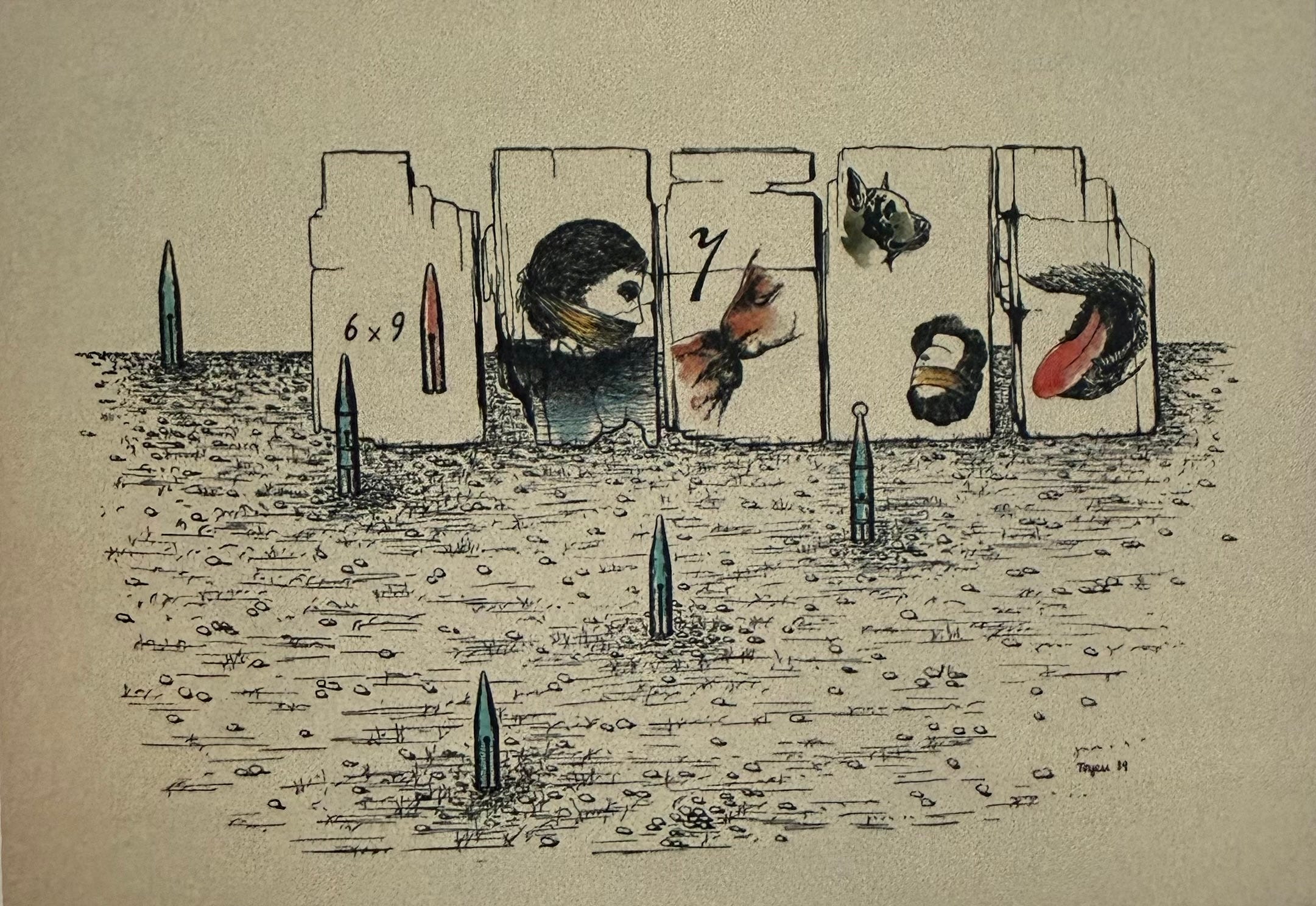
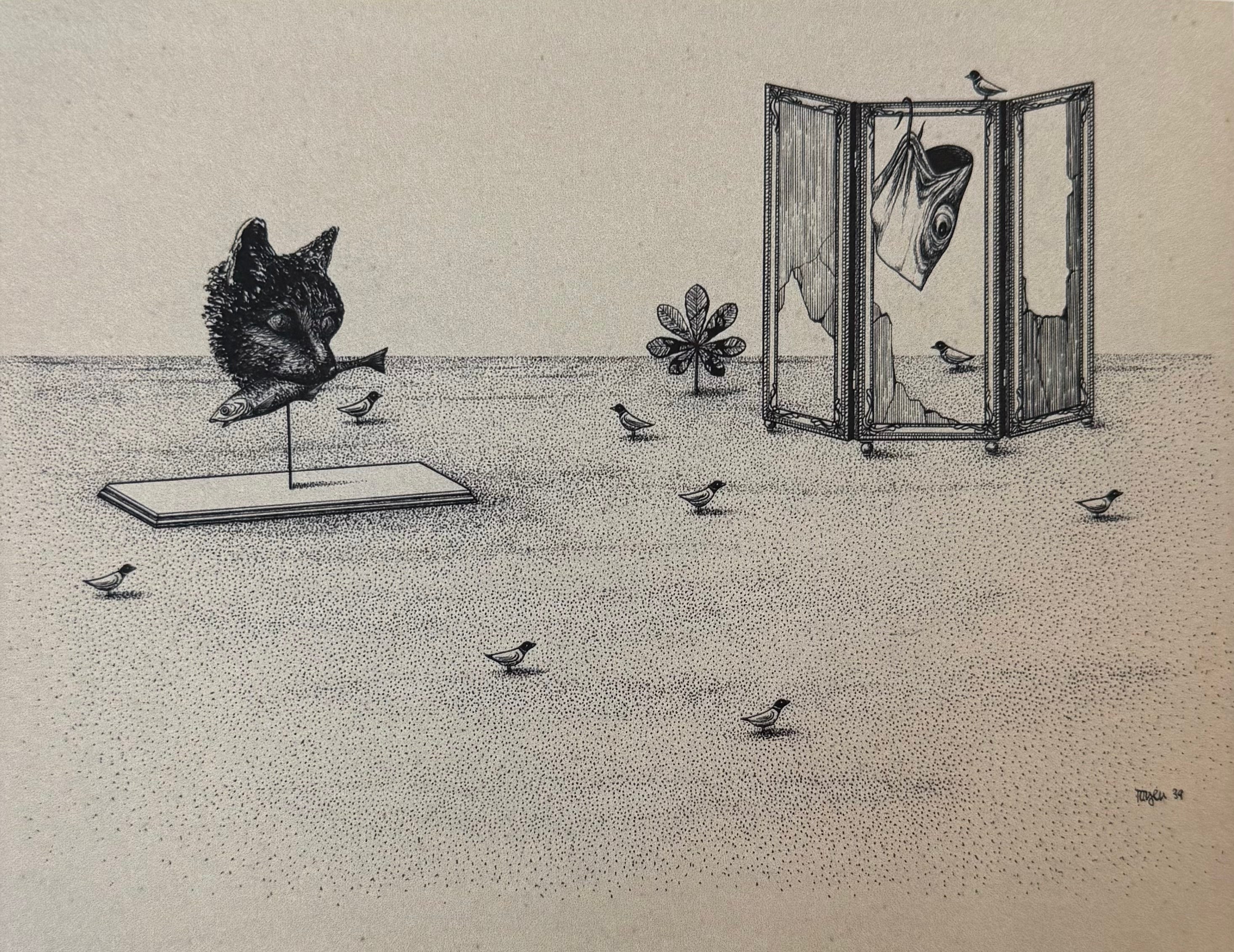
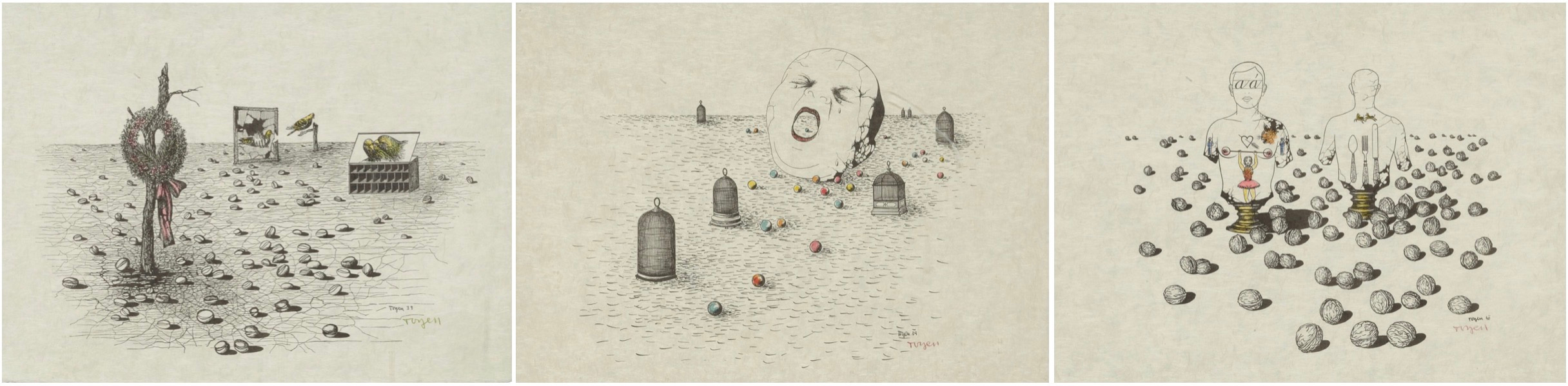
We will come back to The Shooting Gallery in one of the deep dives. It deserves a slow look of its own.
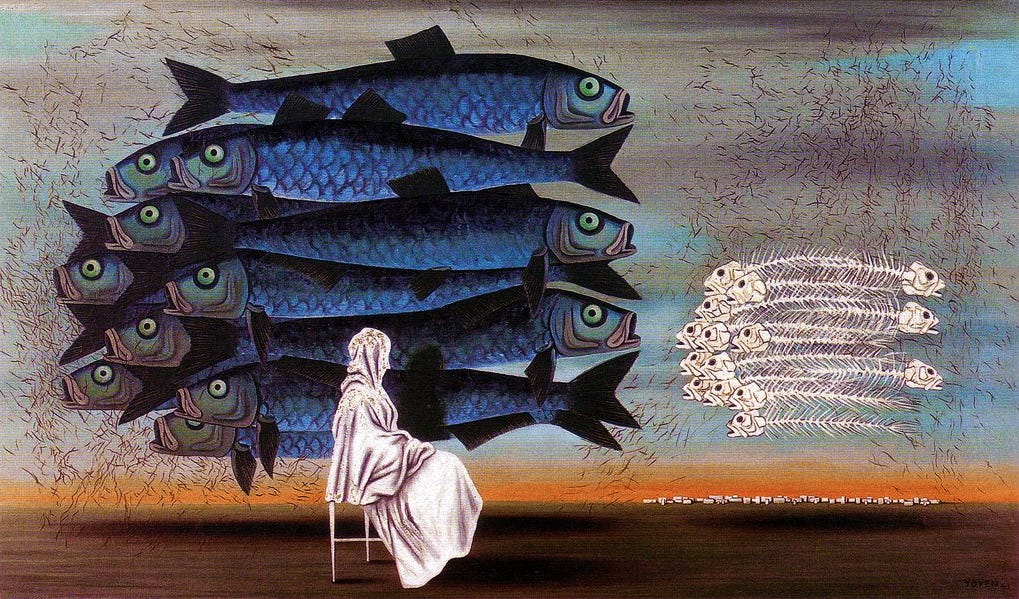
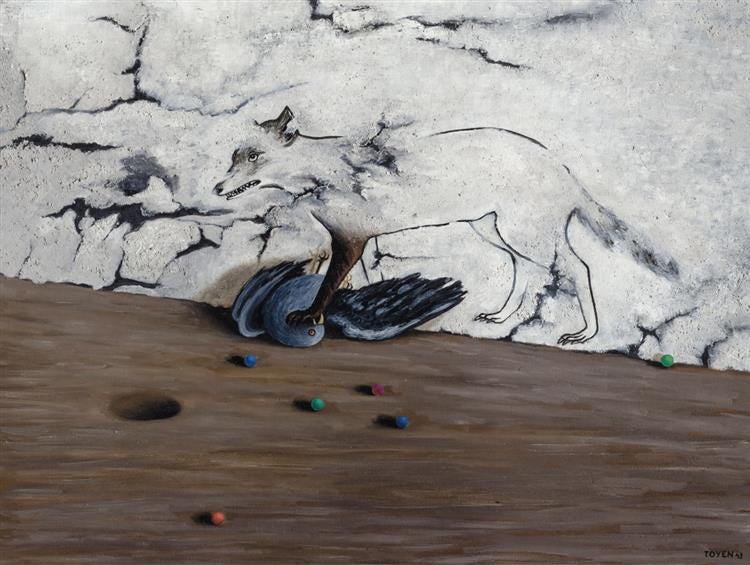
De Sade, a longtime presiding figure in the world Toyen shared with Štyrský, also informs At Château La Coste, titled after the ancestral home of the Marquis.5 The Château had been a Surrealist touchstone since Štyrský’s early 1930s pilgrimage there; the 1943 painting returns to it under wartime conditions, the libertine mythology of Sade now shadowed by actual violence. The painting returns to Štyrský’s photographs years after his initial visit and his subsequent death, folding personal mourning into the Sadean idiom: the painting depicts ruined walls and a predatory fox pouncing on a bird, a homage both to Sade’s exploration of the cruelty of nature and to Štyrský himself, who died of pneumonia in 1942.
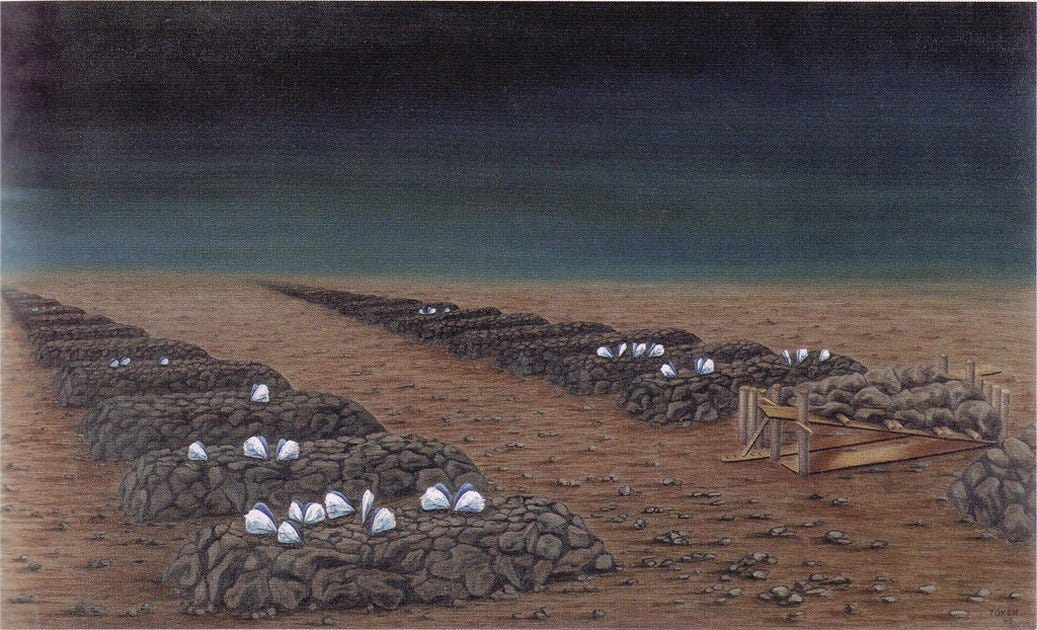
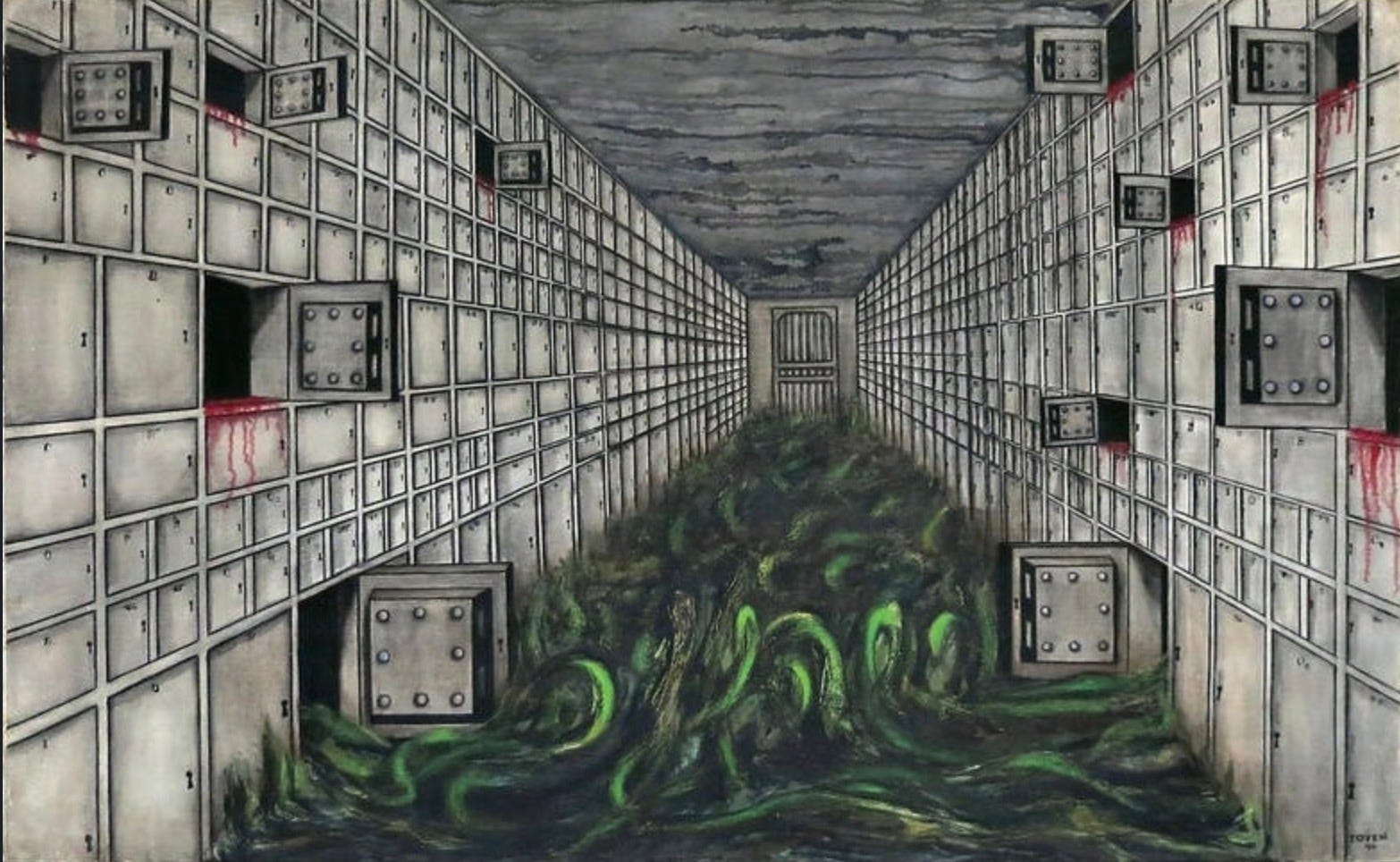
In Early Spring, carnivorous butterflies rain down on a field of graves, a landscape of desolation barely opened onto a glimmer of hope. Safes, from the same period, belongs to this cluster of wartime paintings united by a hyperfine attention to detail that ebbs cryptically into a zone of nonrepresentation or impossibility.
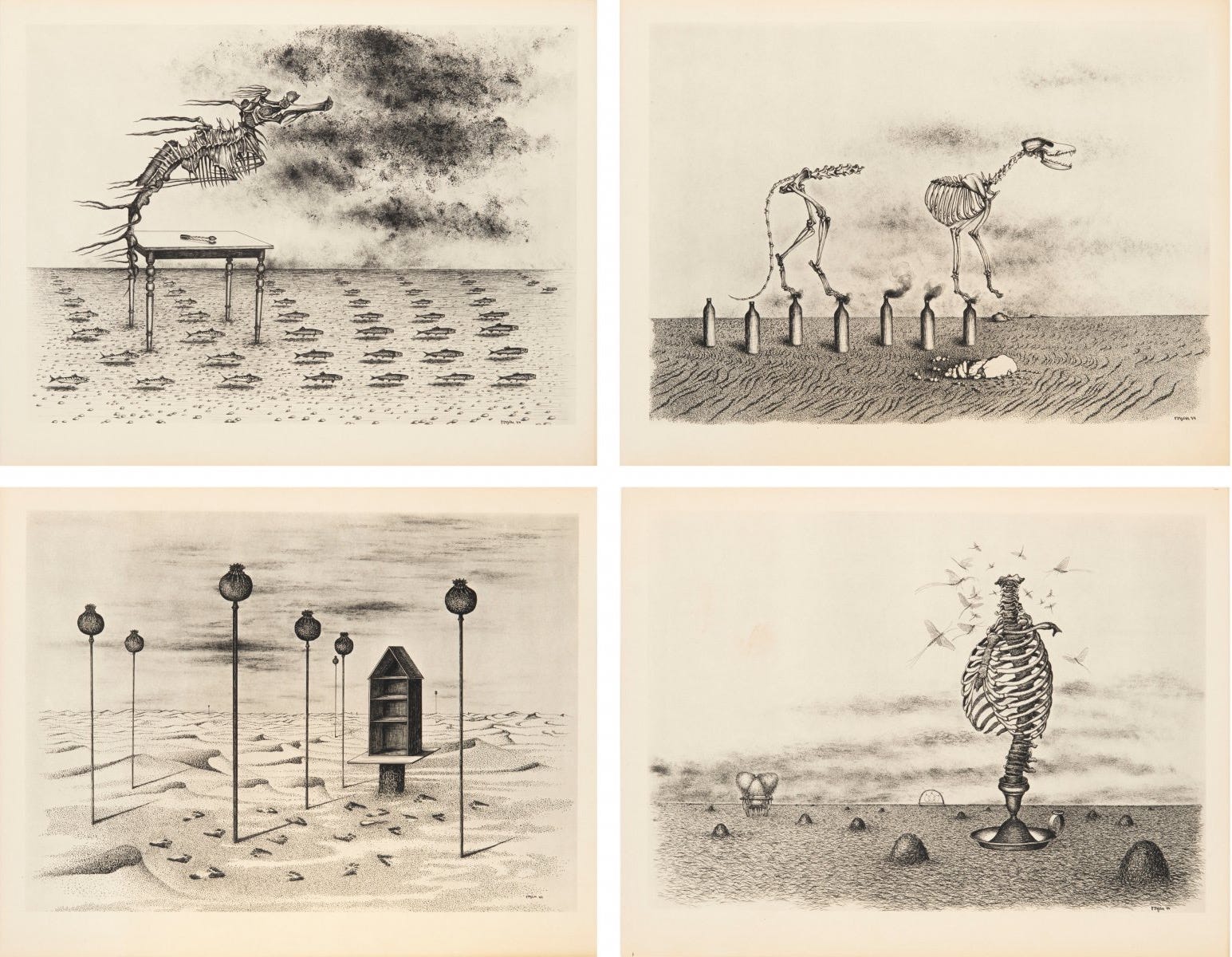
The second major drawing cycle, Hide, War! (Schovej se, válko!, 1944), was a nine-part collection whose title repeats an appeal found in Lautréamont’s Maldoror and Poems.6 All that remains of the animal creatures in these drawings, set in an arid, widely opened space, are skeletons, which nonetheless often act as living beings. Toyen depicted the absurd realistically, with compelling accuracy, as a horrendously vivid dream.
The Long Arrival 1946–1969
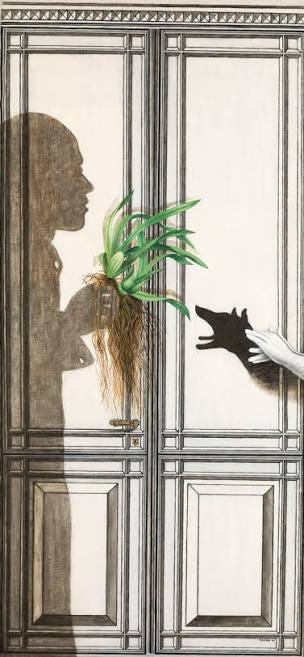
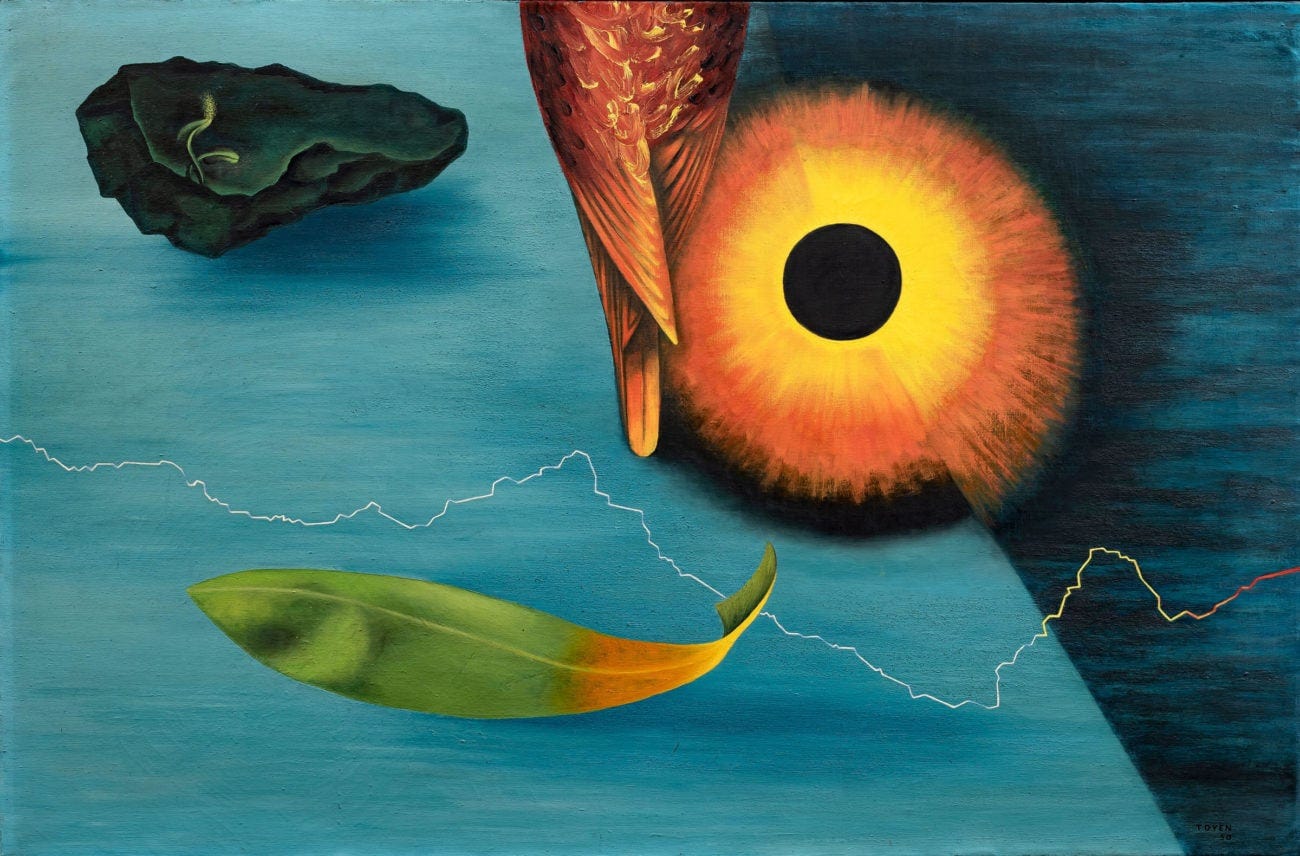
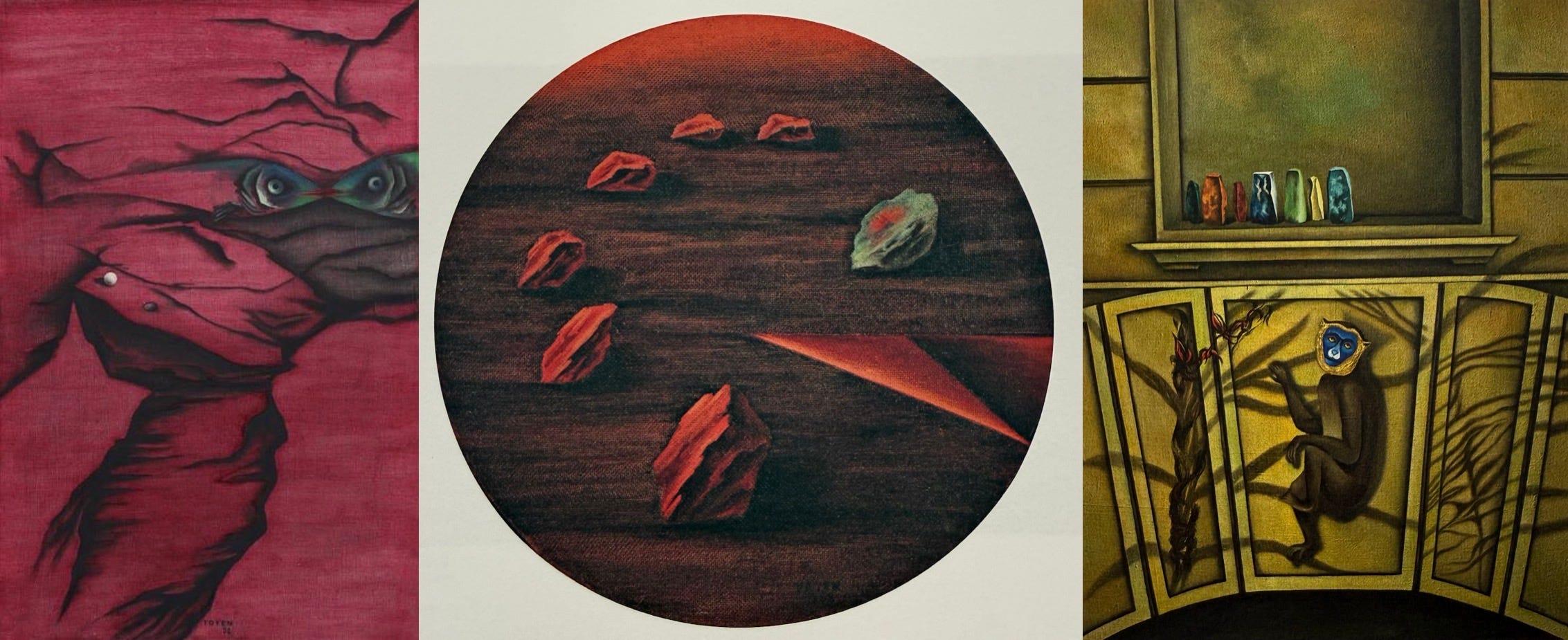
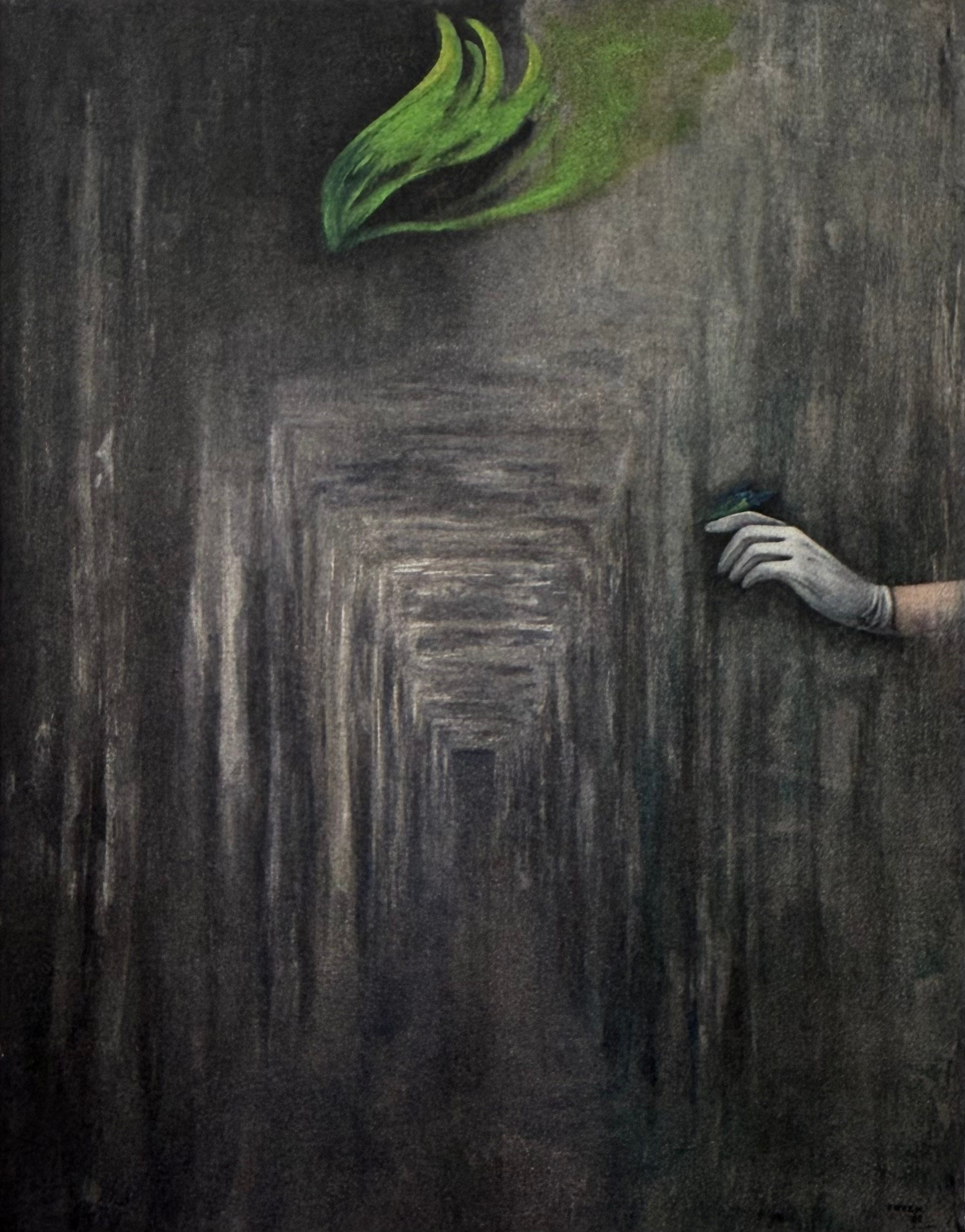
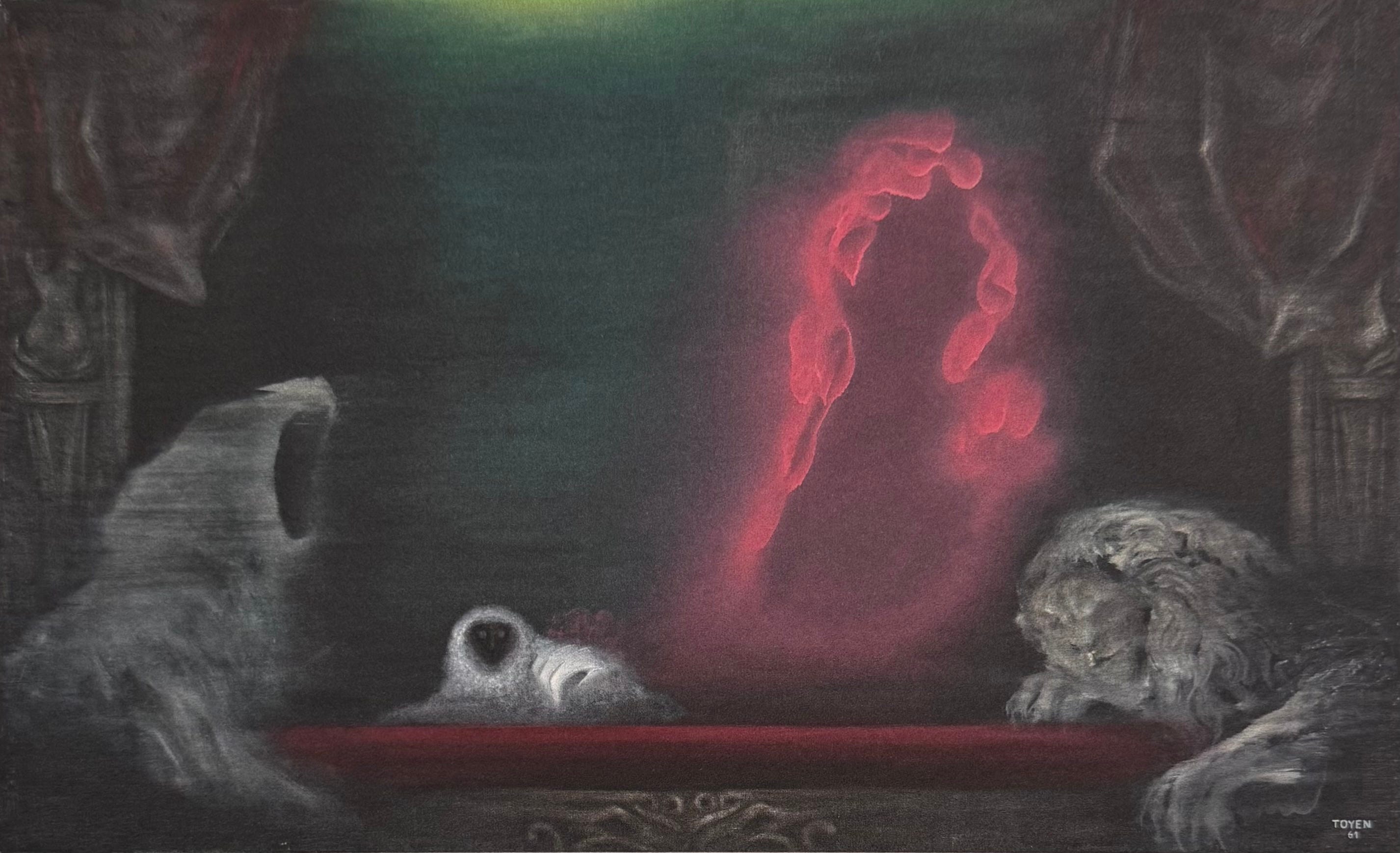
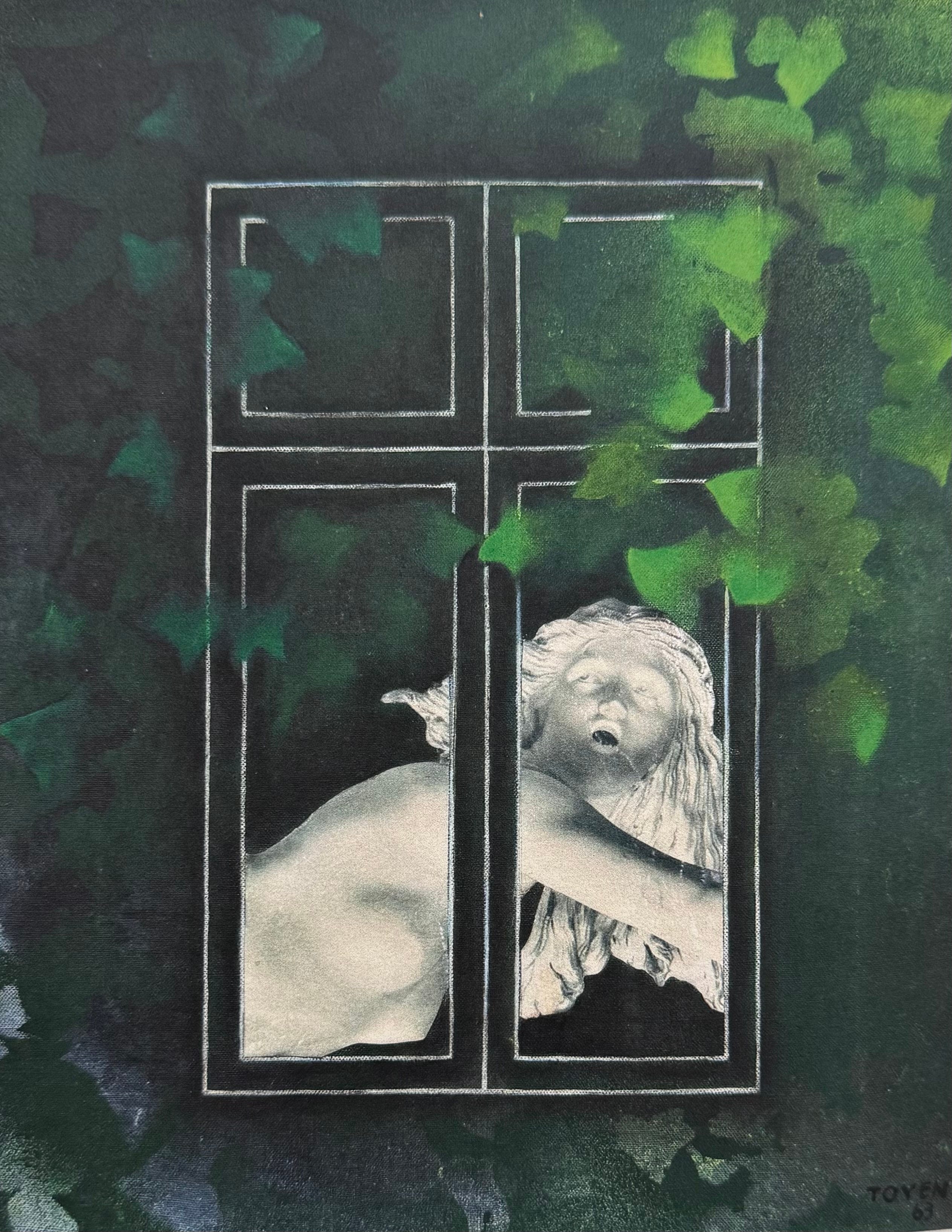
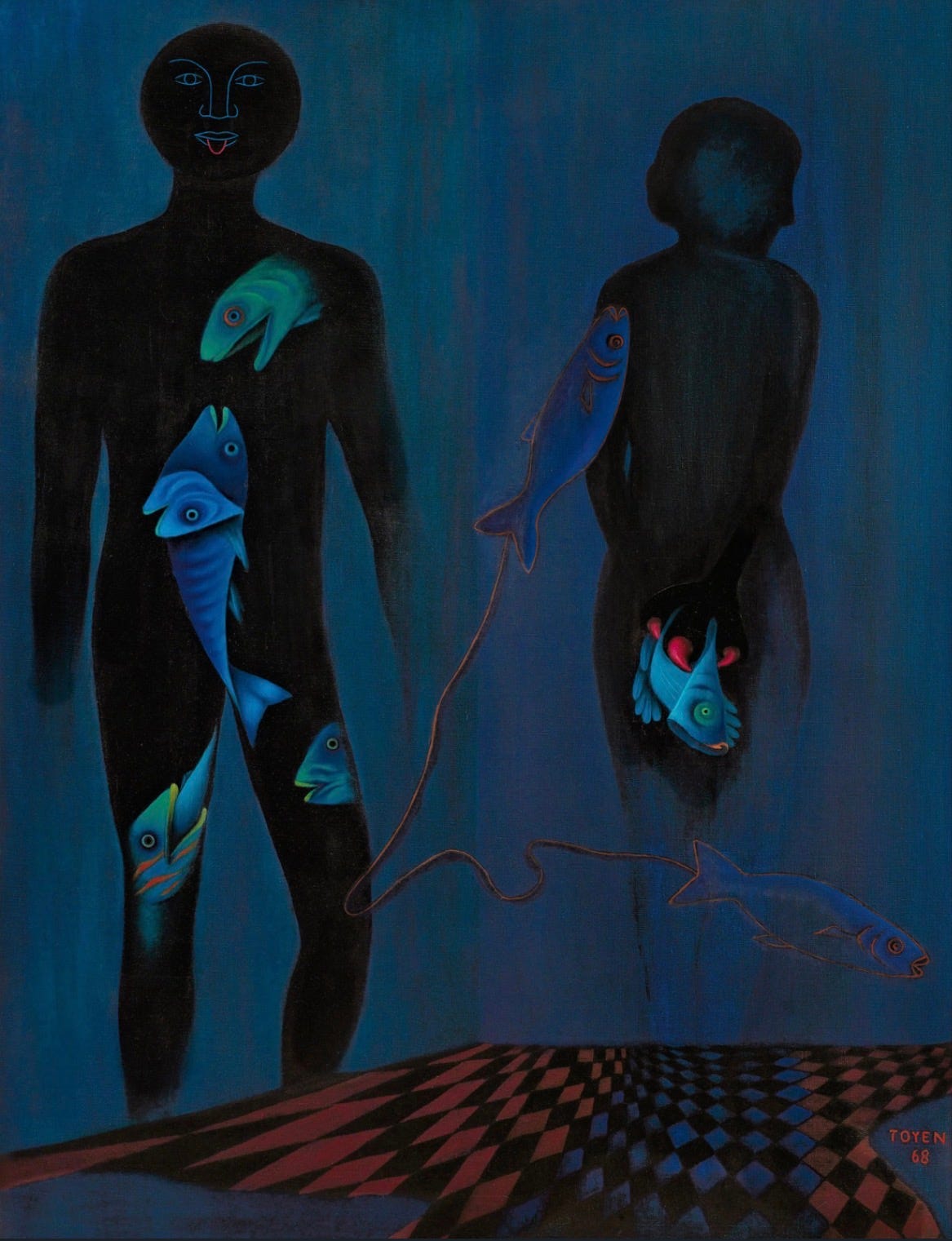
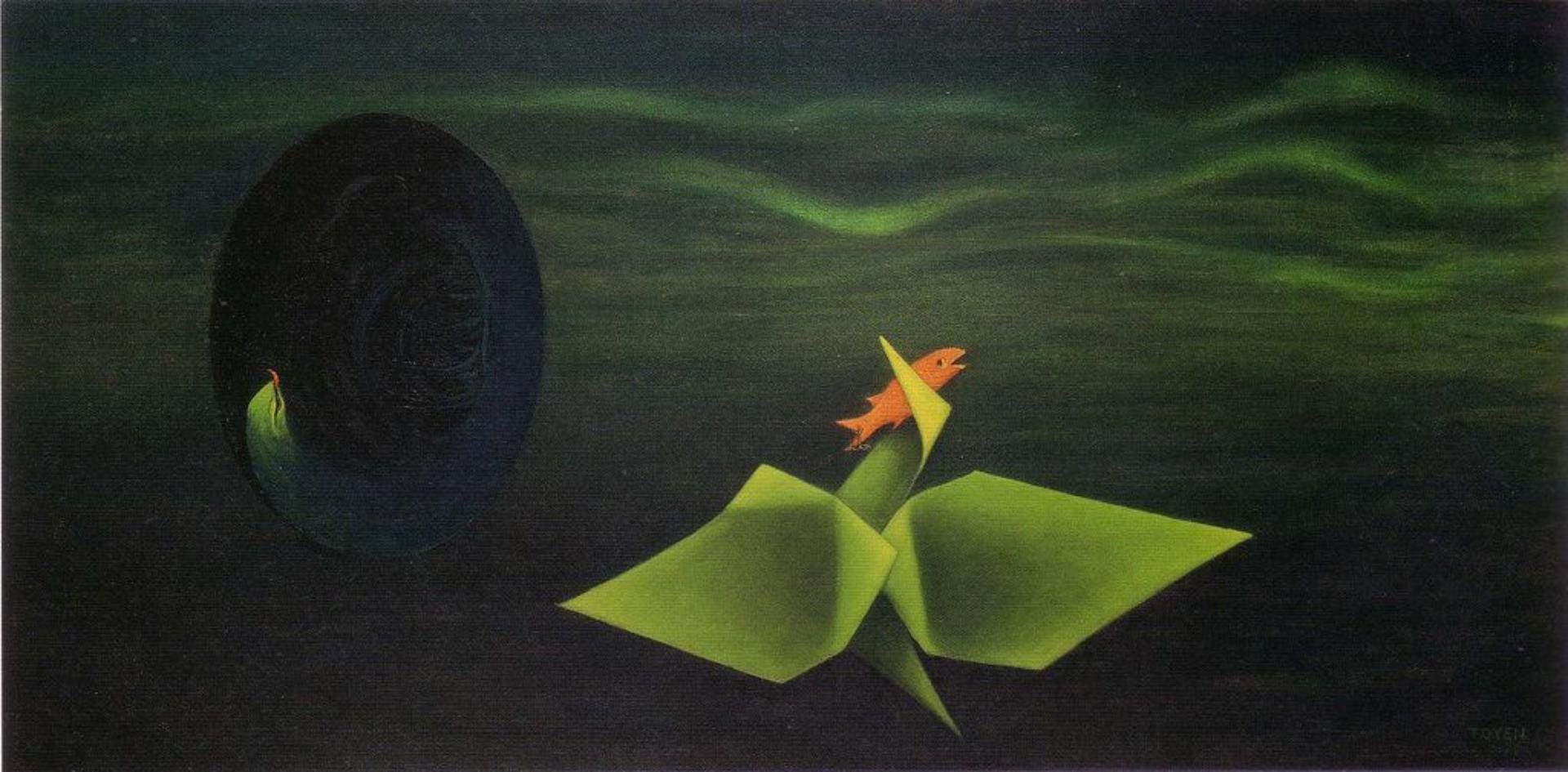
The Myth of Light (1946), one of Toyen’s most iconic paintings, was made for Heisler; by 1953, he was dead. “The war destroyed his heart,” she later told a friend. From April 1947 onward, settled in Paris for good, Toyen attended the daily meetings of the Surrealists, collaborating on projects, exhibitions, and collective declarations surrounding André Breton. Although she took part in all of these events, she occupied a place apart, pursuing her exploration of the erotic through the link between desire and representation. The paintings from this period: All the Elements (1950), The Origin of Truth (1952), The Laundress of the Night (1953), Footsteps are Heard in the Distance (1955), The Night is Rolling Screams (1955), sustain the hyperfine, impossible precision of the wartime works, but the register shifts. The landscapes grow stranger, more interior, as if the outer catastrophe had become fully absorbed into something more private and ungovernable. Writing in his 1953 monograph, Breton observed that Toyen’s most recent efforts showed a tendency to resolve conflicts through “lightning flashes of recognition and the perception of the magical intertwining of invisible links in order to exorcise the sufferings of the past.”
The Final Decade 1970–1980
In 1971, Toyen painted her last oil painting, The Trap of Reality. From that point on she worked almost entirely in drawings, prints, and collages. The shift was partly a matter of health, in early 1976 she suffered an injury and had to work less, but it also reflected where her imagination had been moving for years.
The decade was shaped above all by the Éditions Maintenant collective, the small publishing venture she had helped establish with Radovan Ivšić,7 Annie Le Brun,8 Pierre Peuchmaurd, and Georges Goldfayn. Their meetings happened in cafés or at the flat Ivšić shared with Le Brun, continuing the intense exchanges of ideas that had defined the Surrealist group in Breton’s time. Toyen, characteristically, was the quietest presence. Annie Le Brun later recalled that there was not a single debate she would not heat up with a word or silence, a single impasse to which she would not point.
“There was not a night without a sphinx,” Le Brun wrote. “Toyen was a sphinx and a lynx.”
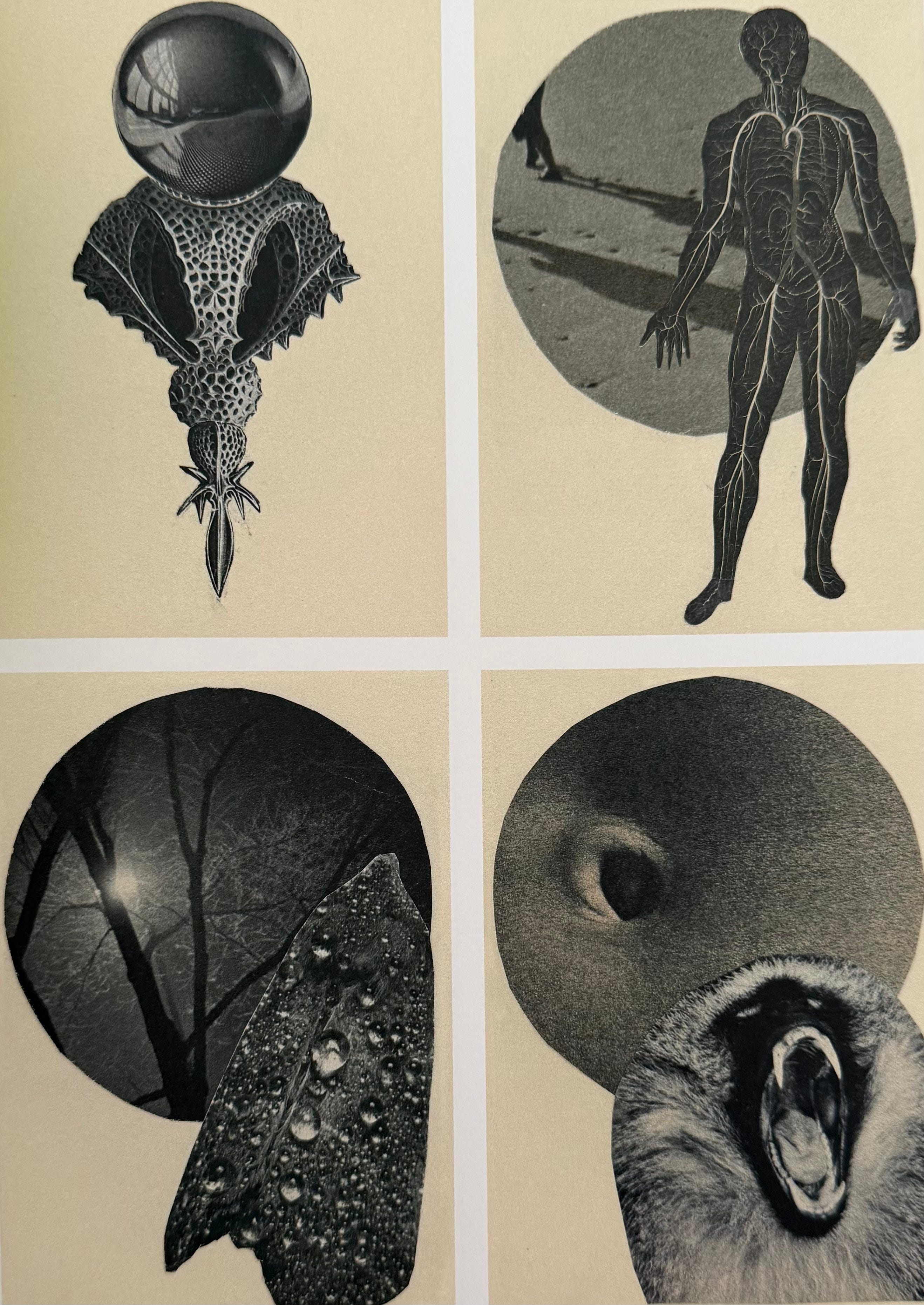
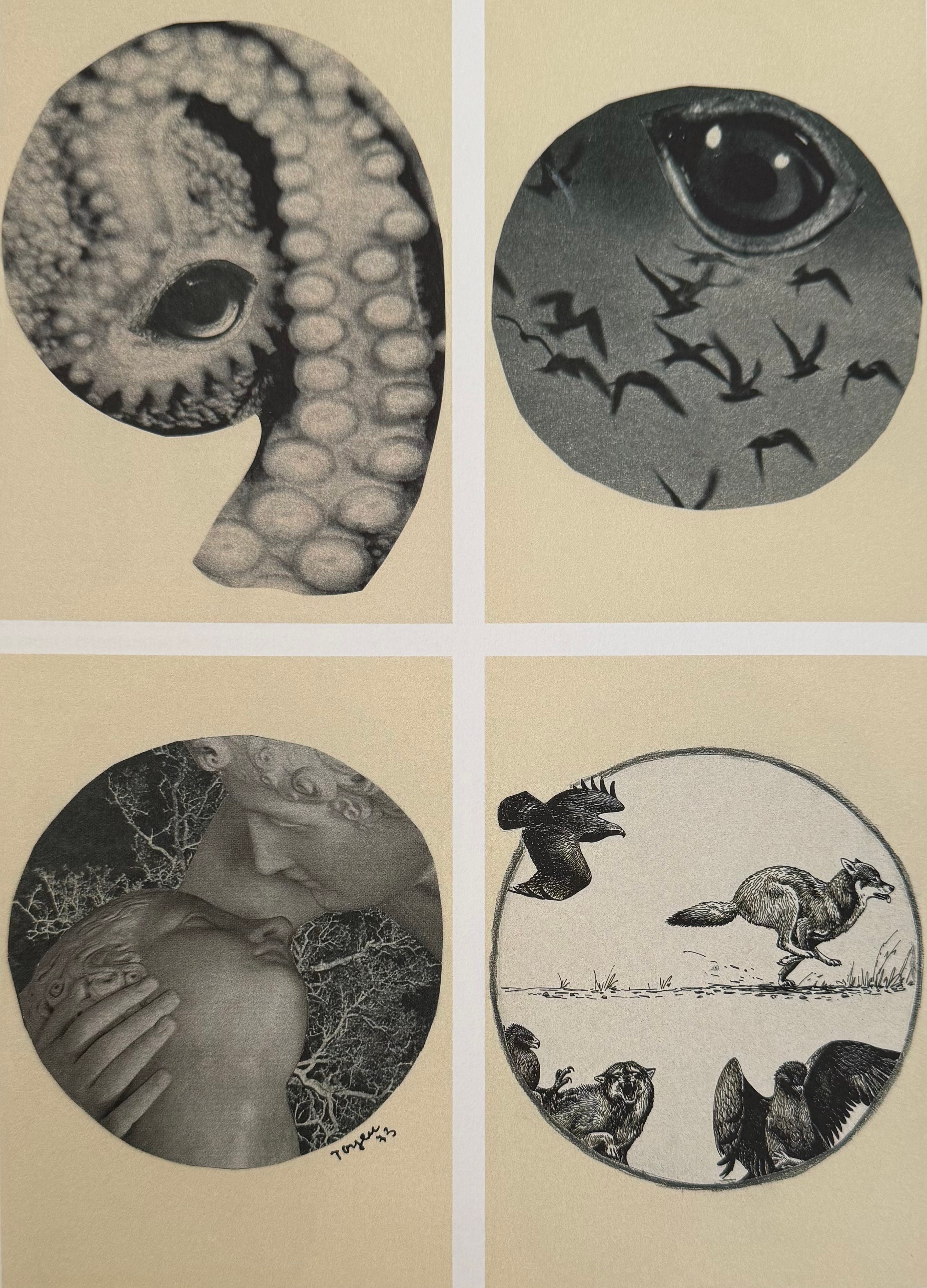
The work she produced for and around Éditions Maintenant is some of the strangest of her career. The Vis-à-Vis cycle (1973) consists of twelve black-and-white collages on green paper, reduced to the barest elements: circular cut-outs, shadows, anatomical fragments, a moth’s wing against a moonlit branch. She combined the microscopic and the macroscopic, close-up and wide view, destabilizing the viewer’s sense of scale.
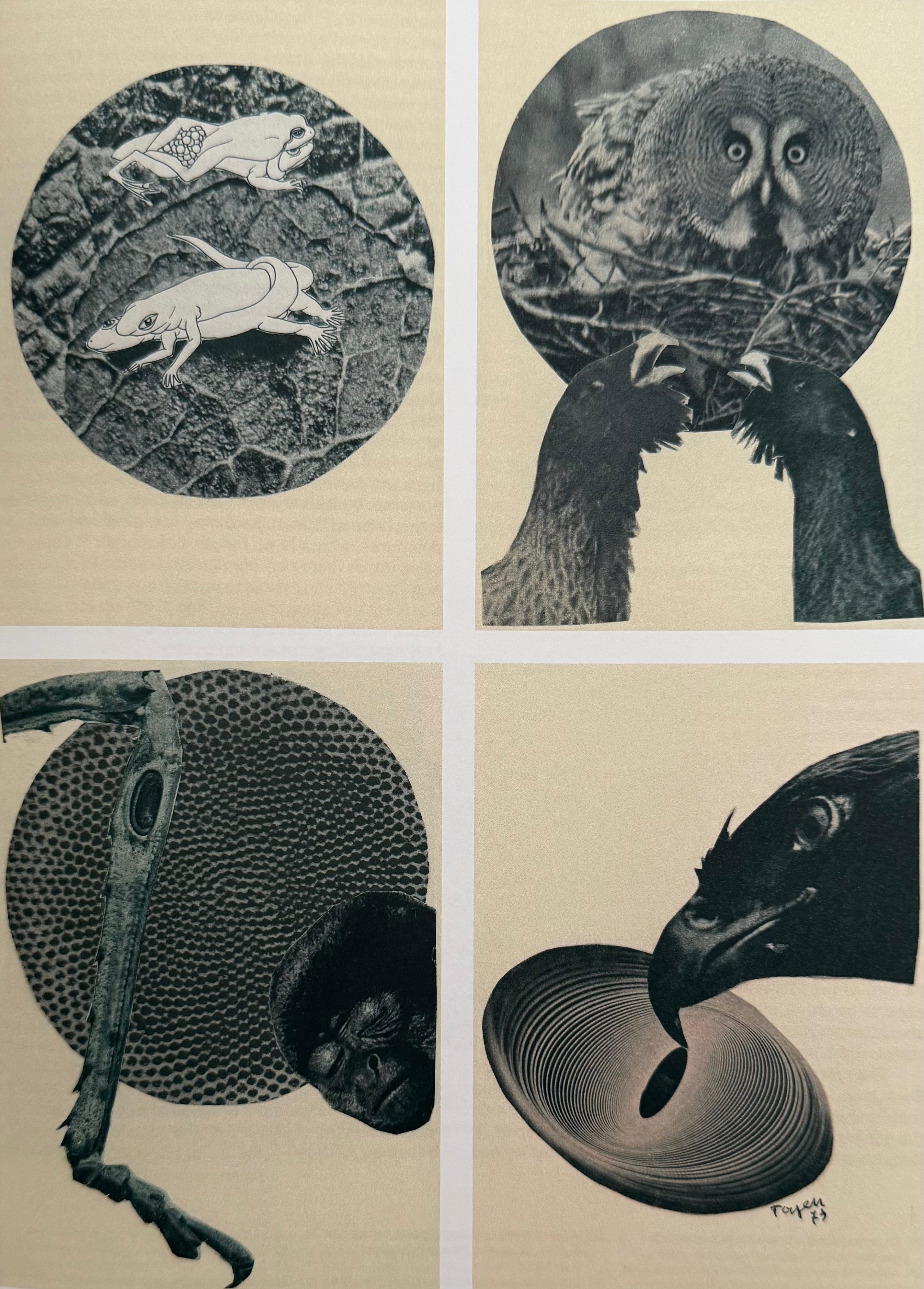
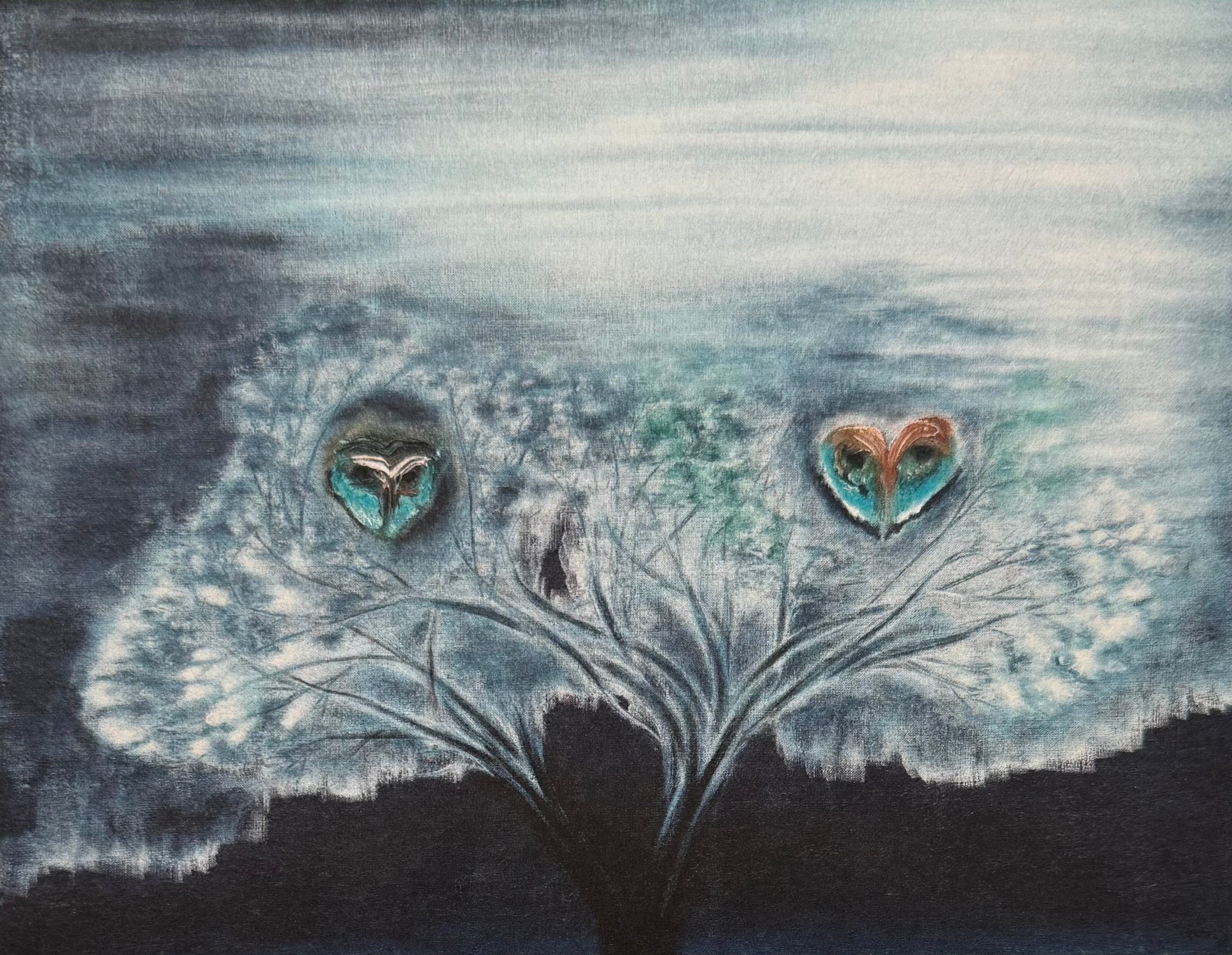
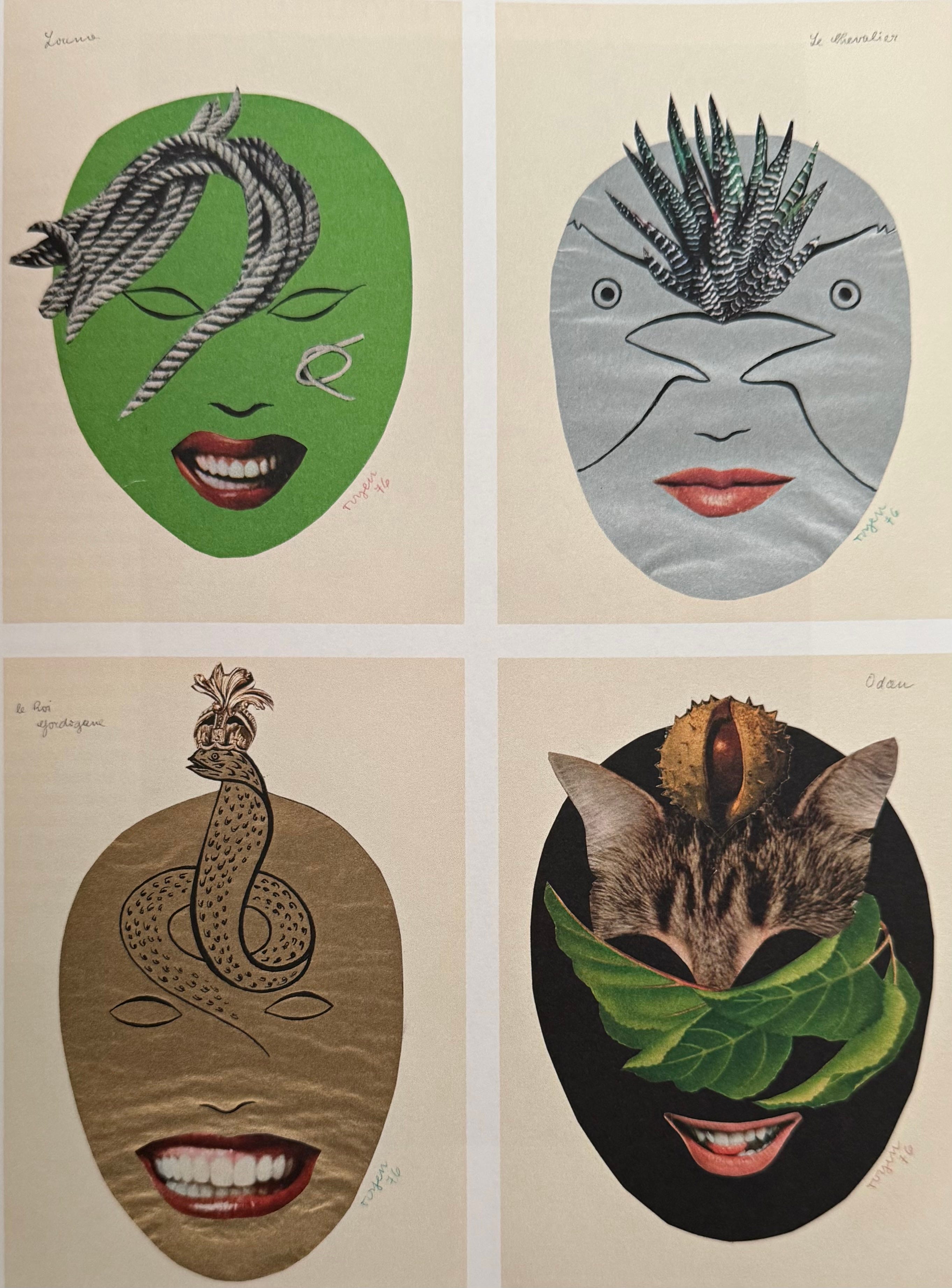
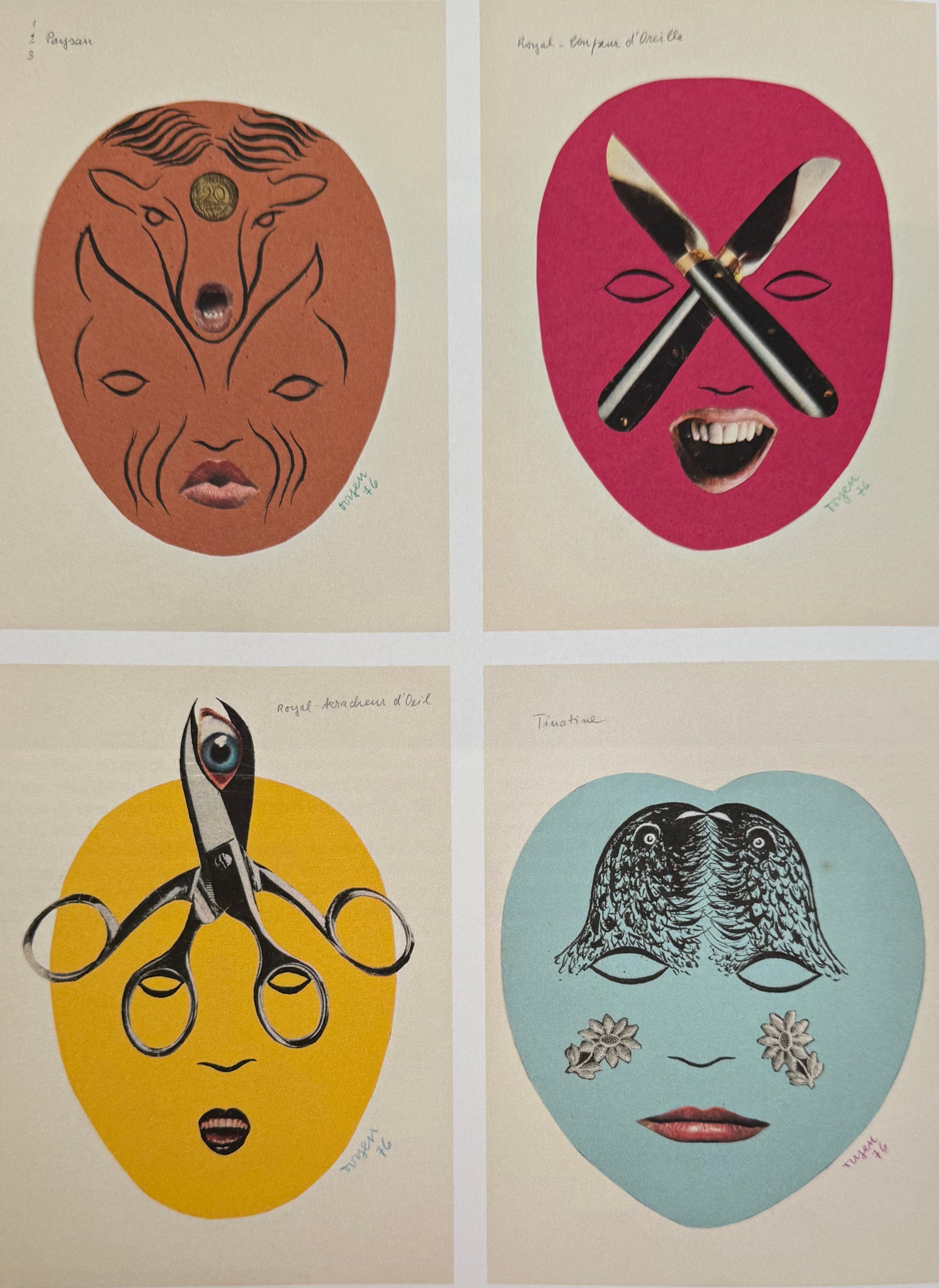
Then there are the eleven Venetian-type masks she made in 1976 for the stage production of Ivšić’s play Le Roi Gordogane. Each is hand-titled and signed. A peasant face with a fox’s nose and a coin at the third eye. A royal face bisected by crossed knives, teeth bared below. Scissors gripping an extracted eyeball. Two owls forming a brow above a sleeping mouth. They are costume pieces and they are also something else entirely: a compressed iconography of violence, desire, and disguise that she had been building since the 1930s, now reduced to oval shapes on coloured paper.
Toyen died in Paris on 9 November 1980. She was buried in Batignolles Cemetery, alongside André Breton and Benjamin Péret. Her estate, auctioned the following June, included works by Štyrský, Heisler, and Teige alongside her own. Annie Le Brun, writing for the 2021 retrospective at the Musée d’Art Moderne de Paris, offered the only epitaph that fits: “Never giving up on her revolt or her dreams, she never allowed herself to be held back by anything that confines one to gender, role, ideology. Like Rimbaud, she is elsewhere.”
What this month’s gallery cannot show, and what the following three paid posts will, is something underneath the surface of Toyen’s work that the chronology alone won’t give you. It requires looking very slowly. That is what the next three posts are for. ♦
Toyen’s erotic work, the Erotická revue illustrations, the explicit drawings made within and for the Surrealist circle, is a significant part of her work and I am not going to pretend otherwise. It isn’t here because Substack restricts explicit imagery, not because it doesn’t matter. It is not difficult to find online, and if you’re going further with this artist, it’s worth looking it up.
Let’s Chat TOYEN
I have been living with these images for weeks now and some of them I still can’t quite explain. Which one stopped you, and what do you think it was doing to you?
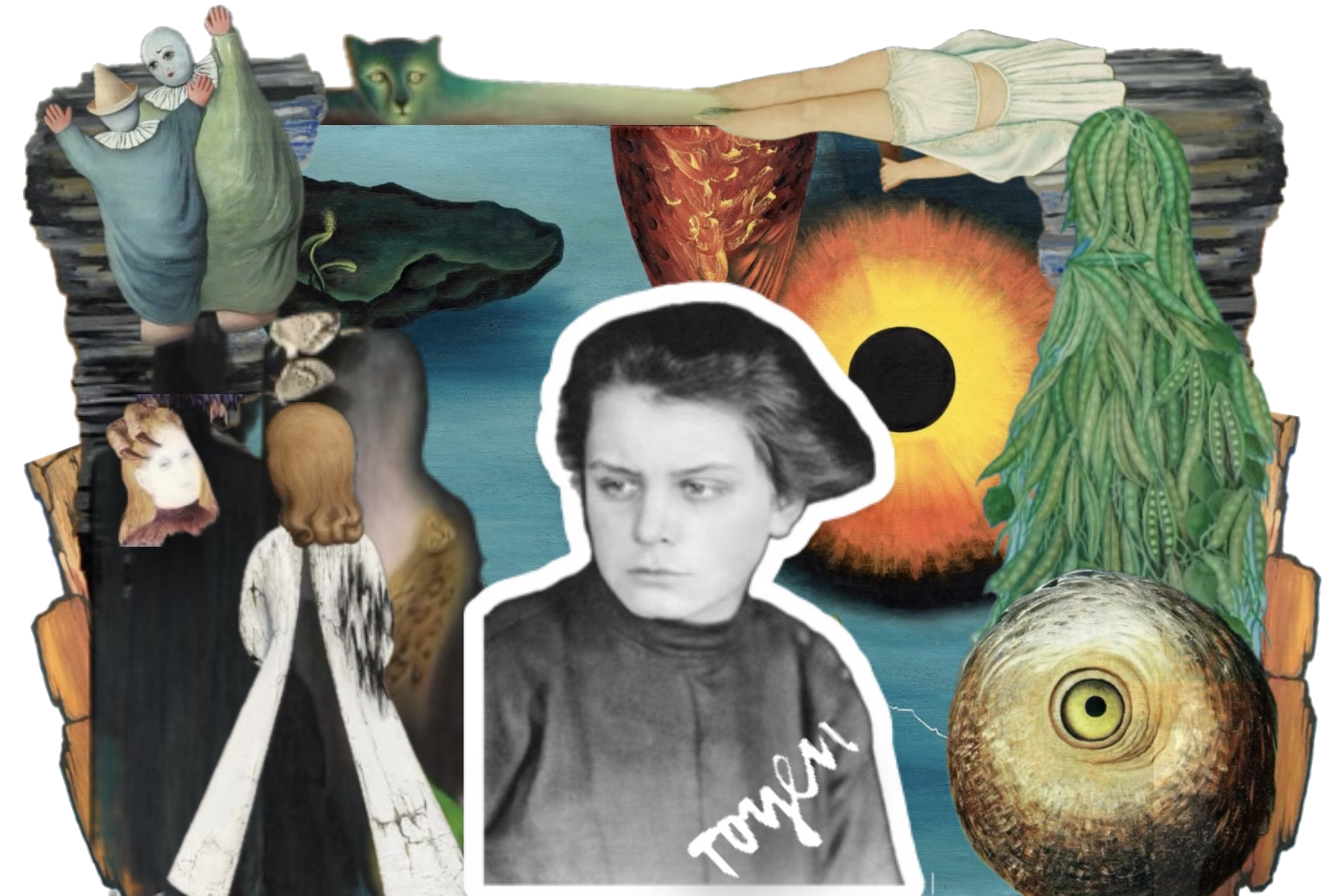
What follows across May is three paid posts, each built around a single work. The first deep dive goes into the Artificialism the mysterious and misunderstood movement she created with Styrsky. The second deep dive takes The Shooting Gallery (1939-40), a cycle of twelve drawings made under Nazi occupation, and arguably one of the most important works in the history of Surrealism. The final post starts with Relâche (1943), a figure hanging upside down, headless, dissolving into the wall, and follows the disappearing body through the rest of her career. What was Toyen doing with all that vanishing?
Jindřich Štyrský (1899–1942): Czech Surrealist painter, photographer, and poet, best known for his erotic collage series and his decades-long artistic and personal partnership with the painter Toyen. Together they founded Artificialism in Paris in the 1920s before returning to Prague, where they remained central figures in the Czech Surrealist movement until Štyrský’s early death at forty-two.
Artificialism: a movement founded by Štyrský and Toyen in Paris in 1926, rejecting direct representation in favor of evoking psychological states through color, texture, and form, closer to lyrical abstraction than to Surrealism proper, though both artists moved toward Surrealism within a few years. It was always a movement designed for two, it began and ended with Štyrský and Toyen, and no significant artists adopted it after them. It was described as “a lost chapter of the avant-garde” by the Museum of Fine Arts Houston.
European avant-garde broadly termed “primitive” sources: naïve or folk-style visual language, flattened figures, an uninhibited handling of eroticism. The series was linked, in part, to her encounter with the variety and spectacle of Paris, including its circuses, music-halls, and fairground culture, and carried the same erotic charge as the small sketches she was making simultaneously. The phase is brief and sits awkwardly in the critical literature on Toyen, precisely because it cannot be separated from the wider avant-garde appetite for “otherness” as transgression, an appetite that had its own politics. It is best understood as a transitional moment between her early Cubist-influenced work within Devětsil and the Artificialism she developed with Štyrský from 1926 onward.
Devětsil [DEH-vyet-sil] was a Czech avant-garde collective founded in Prague in 1920, bringing together artists, writers, architects and musicians under a broadly leftist and internationalist orientation. The name means both “nine forces” and the Czech word for butterbur, a common wildflower. Toyen and Štyrský were among its central figures, and it was within this circle that Artificialism developed. The group dissolved in 1931.
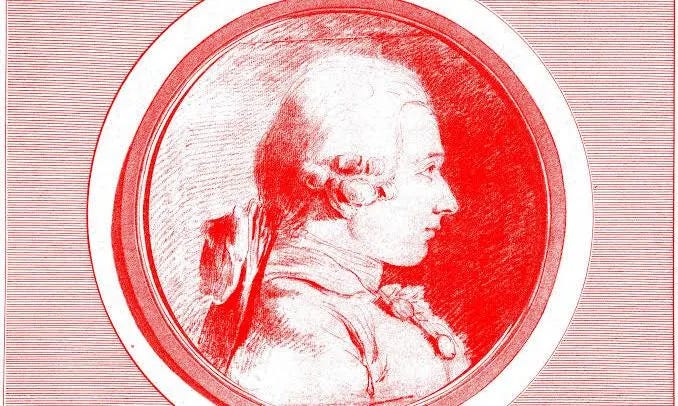
DeSade’s relationship to visual artists: Štyrský made a pilgrimage to Provence in 1932 to photograph the ruins of the Château La Coste, the Sade family’s ancestral estate. His photographs and a short accompanying text, “The Landscape of Marquis de Sade,” were published in 1933 and later collected in Život markýze de Sade (Prague: Kra, 1995); an English translation appeared in Dreamverse (Twisted Spoon Press, 2018). The Sade engagement was not incidental but structural to the whole Edice 69 project: Štyrský published erotic literature under the Edice 69 imprint, including texts by Aragon, Bataille, and Lautréamont’s Maldoror, alongside his own written studies of Rimbaud and de Sade. Toyen’s 1932 illustrations for the Czech Justine appeared within this same imprint and marked the beginning of an erotic engagement that would inflect her work for decades. For the broader Surrealist context, Sade’s relationship to visual artists was examined in Sade/Surreal, a 2001 exhibition at the Kunsthaus Zürich curated by Tobia Bezzola, and later in Sade: Attaquer le soleil, curated by Annie Le Brun and presented at the Musée d’Orsay in 2014, the latter curated by Toyen’s own closest Paris friend and collaborator.
Les Chants de Maldoror (1868-69) and Poésies (1870) are the complete works of Isidore Ducasse, who wrote under the name Comte de Lautréamont. He died in Paris at 24, in 1870, leaving only these two texts. Maldoror is a prose poem in six cantos, following a figure of absolute evil: Maldoror, who has renounced God and humanity and moves through a series of violent, blasphemous, and sexually transgressive episodes. The writing is hallucinatory and deliberately unhinged: long Homeric similes that collapse into the grotesque, sudden shifts of register, apostrophes to the reader. The most famous line: the chance meeting of a sewing machine and an umbrella on a dissecting table, became the Surrealists’ de facto definition of their own aesthetic. The Surrealists claimed him as their direct ancestor, Breton’s first manifesto (1924) named him explicitly. What drew them, and drew Štyrský so obsessively, was the combination of transgression, black humor, and the sense that the text had been written from somewhere outside normal human psychology. The violence in Maldoror isn’t pornographic in the way Sade’s is.
Radovan Ivšić (1921–2009) a Croatian poet and playwright who relocated to Paris in 1954 and became a close friend of both Breton and Toyen, signing the final Surrealist manifesto in 1955. Toyen illustrated his Le puits dans la tour (1967) and contributed two new drypoints to the 1973 Paris reedition of The Shooting Gallery, accompanied by his poem “Les grandes ténèbres du tir.” In 1972, Ivšić (by then Annie Le Brun’s companion) co-founded Éditions Maintenant with Le Brun and Toyen, the press through which several of their late collaborations were published.
Annie Le Brun (1942-2024) a French poet, essayist, and the critic most closely identified with Toyen’s late Paris work and legacy. She met Breton in 1963 and participated in the Surrealist group until its dissolution in 1969; Toyen illustrated her collections Sur le champ (Éditions surréalistes, 1967), Tout près, les nomades (Maintenant, 1972), and Annulaire de lune (Maintenant, 1977). Le Brun co-curated the major Toyen retrospective at the Musée d’Art Moderne de Paris in 2021, for which she wrote the catalogue essay. Her critical writing on Toyen, and on Sade, whose complete works she prefaced for Jean-Jacques Pauvert in 1986, makes her the connective tissue between the two obsessions that run through Toyen’s final decades.
The painting that stopped me during research was not one of the famous ones. It was Chinese Tea Shop, 1927; made before Surrealism, before the war, before everything. I keep coming back to it. What about you?
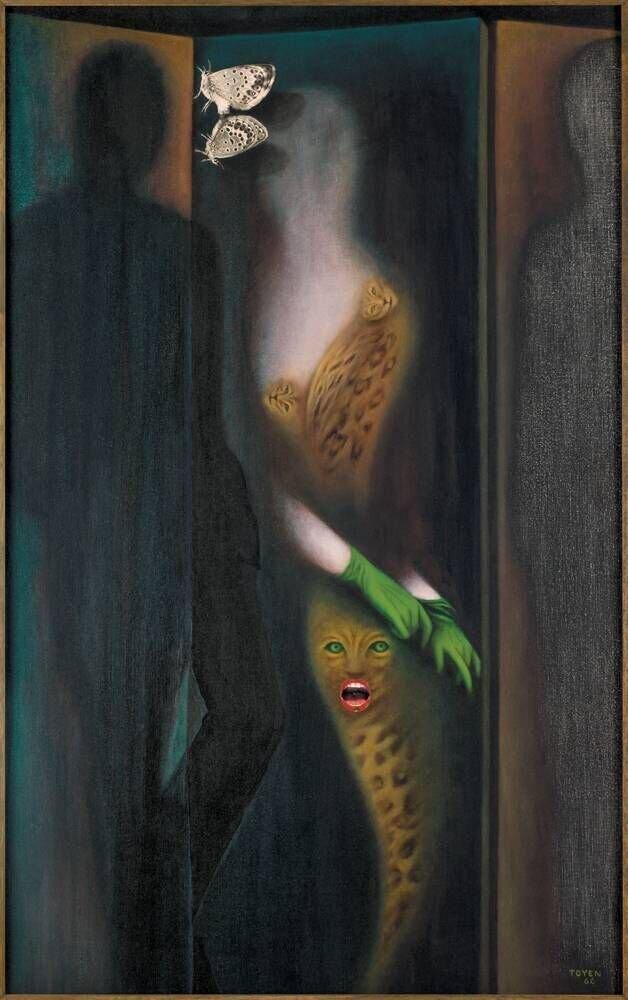
Interesting body of work. I recognised Screen, but was unfamiliar with her other pieces. Sleeping, At La Coste Castle, and Safes stand out for me: paintings that one 'feels' rather than sees - love the eeriness particularly the snake-creatures in Safes. Another discovery. Look forward to learning more