

The Lady Vanishes
| Pt. 3 of 4 | Deep Dive II: Toyen’s disappearing bodies in the Surrealist 1930s

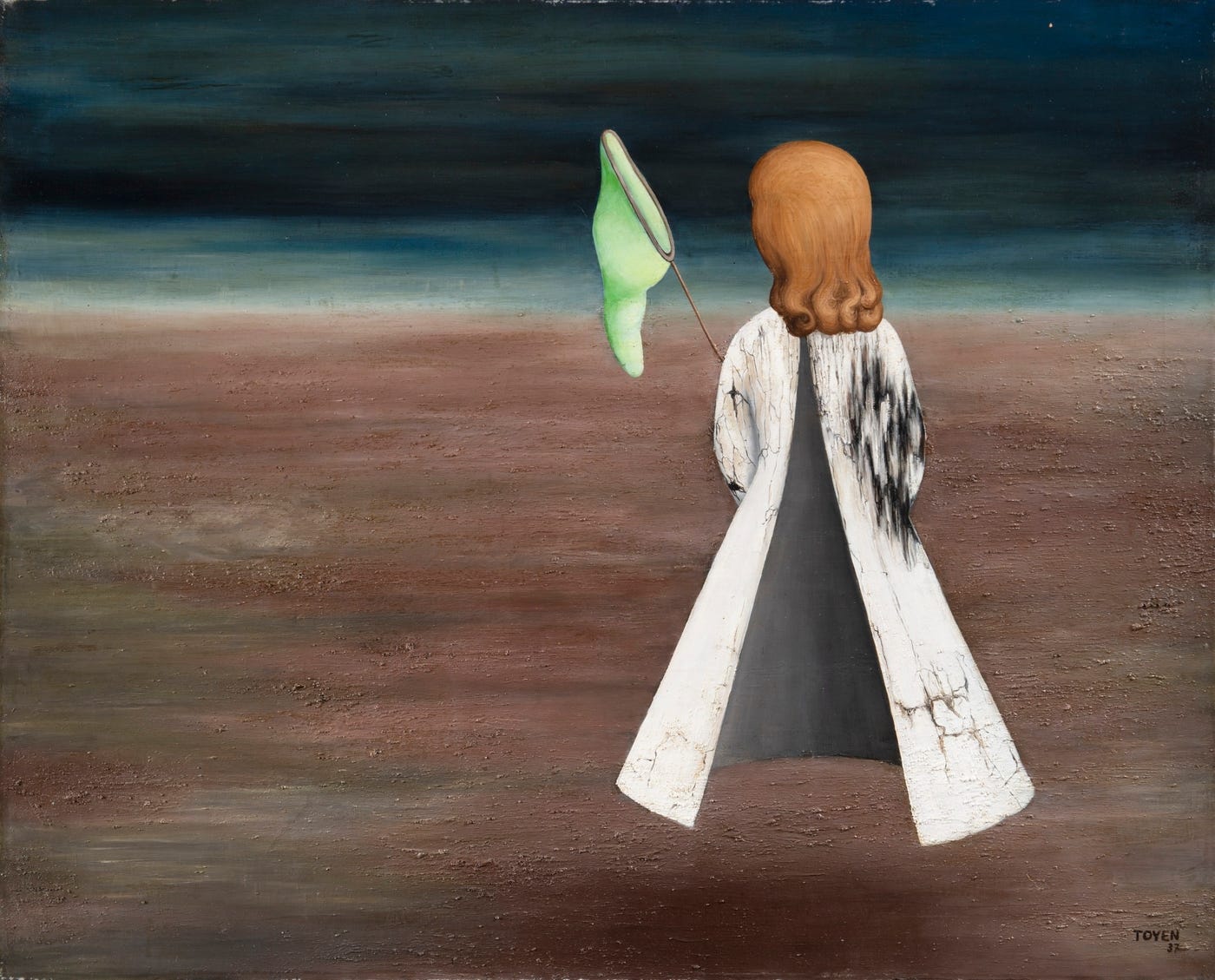
While looking through what has been written on Toyen’s work of the 1930s (not much), her vanishing figures in particular, I came across Jindřich Toman, who wrote in 2018 that Toyen’s hollow bodies are a register of the cultural melancholy of 1930s Czechoslovakia. The emptied form as a symbol of mourning, the absent figure as a register of what was coming. That reading is true as far as it goes, but in this context melancholy is a response to loss, and I was not convinced that it was the ultimate way to read it. As I continued looking into what was happening in the Surrealist circle at that time a certain set of ideas started coming together.
In the mid-1930s, another thinker from Toyen’s circle was working on something concerning the vanishing of bodies. Roger Caillois published “Mimicry and Legendary Psychasthenia” in Minotaure two years after Toyen’s Sleeping. The essay opens with insects: stick insects, leaf insects, the kind that disappear so completely into their surroundings that predators stop seeing them. Caillois argued this was not camouflage in the protective sense. He described how the organism is drawn into its background not by force but by compulsion, loosening its edges until figure and ground can no longer be distinguished. He called it pathology, but as the essay unfolds he extends the claim outward.1 The mimetic insect and the artist are doing versions of the same thing. The paintings of Dalí, he writes, with their melting clocks and merging bodies and landscapes that become faces, are not the products of paranoid hallucination (which is how Dalí described his own method) but are instead the painter’s hand performing the same operation as the insect: dissolving the boundary between animate figure and inanimate ground. Art is what happens when the body wants to become space. How peculiar, I thought, that someone was preoccupied with this particular idea at a time when the Surrealist circle had already set its course around the unconscious and the dream. Why challenge it further?
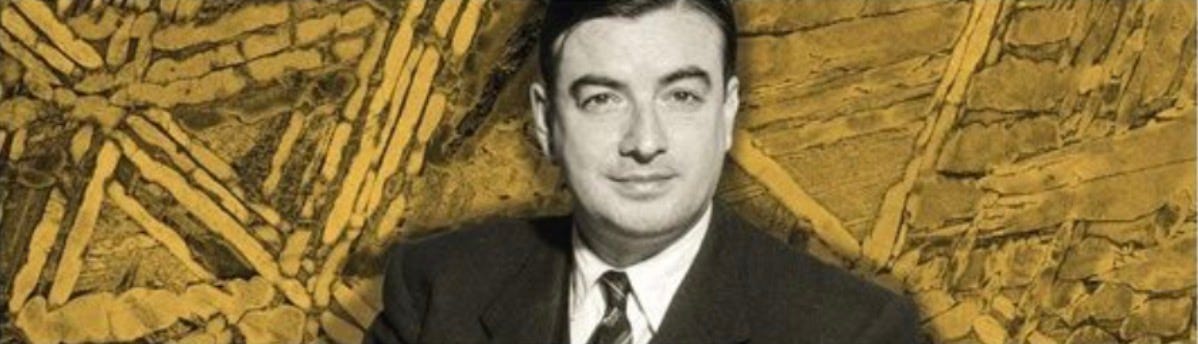
Caillois was twenty-two at that time, and he had just entered the orbit of Minotaure and the Surrealist circle through its main gate-keeper Breton. Minotaure, a luxury art review run by Albert Skira2 from 1933-39, functioned as the Surrealists’ most ambitious publication. Deliberately interdisciplinary, it positioned Surrealism as something closer to a total inquiry into the human image. The visual culture of the journal treated biology and dream as continuous. In it one would find mimetic insects next to Picasso or a Brassaï.
Caillois saw an opportunity to introduce a kind of science of the imagination, something rigorous enough to explain why certain images recur without resorting to what he saw as the Surrealists’ over-reliance on Freud. Essentially he was trying to show that the dissolution of the self into space, which the Surrealists were treating as a dream-state or an unconscious operation, is something nature itself performs. He was, in effect, giving Surrealism a biological substrate, but on his own terms.
While Breton admired the essay (and reprinted it sympathetically) his Surrealism remained committed to desire and the individual unconscious. Caillois was already moving toward forces that exceed the individual entirely. By 1935, Surrealism had been split for years into a Bretonist branch organized around dream and desire, and a counter-current around Bataille3 organized around dissolution and the sacred. Caillois belonged to the second, even when he published in the first’s journal.4
Against all this Toyen paints a body of work that, by the same logic, sits closer to the Bataillean current than to orthodox Bretonist Surrealism, even though her Prague circle’s official allegiance was to Breton, who admired Toyen greatly, yet could not place her. Breton had categories for almost every member of his circle, the dream-painter, the automatist, the femme-enfant, but when he wrote about Toyen he reached for metaphor. The image is beautiful and slightly evasive. Part of what made her unplaceable was what she withheld. “‘All that Toyen touched’, Breton wrote, was connected to the wild and utterly free song of the nightingale by ‘a ladder of silk.’”5
Bretonist Surrealism had a very specific role for the woman artist, the femme-enfant,6 the muse, the convulsive image of beauty. Toyen would not occupy that role. She refused the feminine ending in language,7 refused to be Štyrský’s “wife” or “companion” in any conventional sense, refused biographical disclosure, refused to write polemics about her own work, refused even to speak when she judged the room insufficiently poetic. What was Breton supposed to do with her? He admired her, championed her, called her “mon amie entre les femmes” and one of his “claqueurs of dreams,” but he could not subsume her under any of his categories. All Breton had were her paintings, of which she would provide no explanations, not to him, not to anyone.
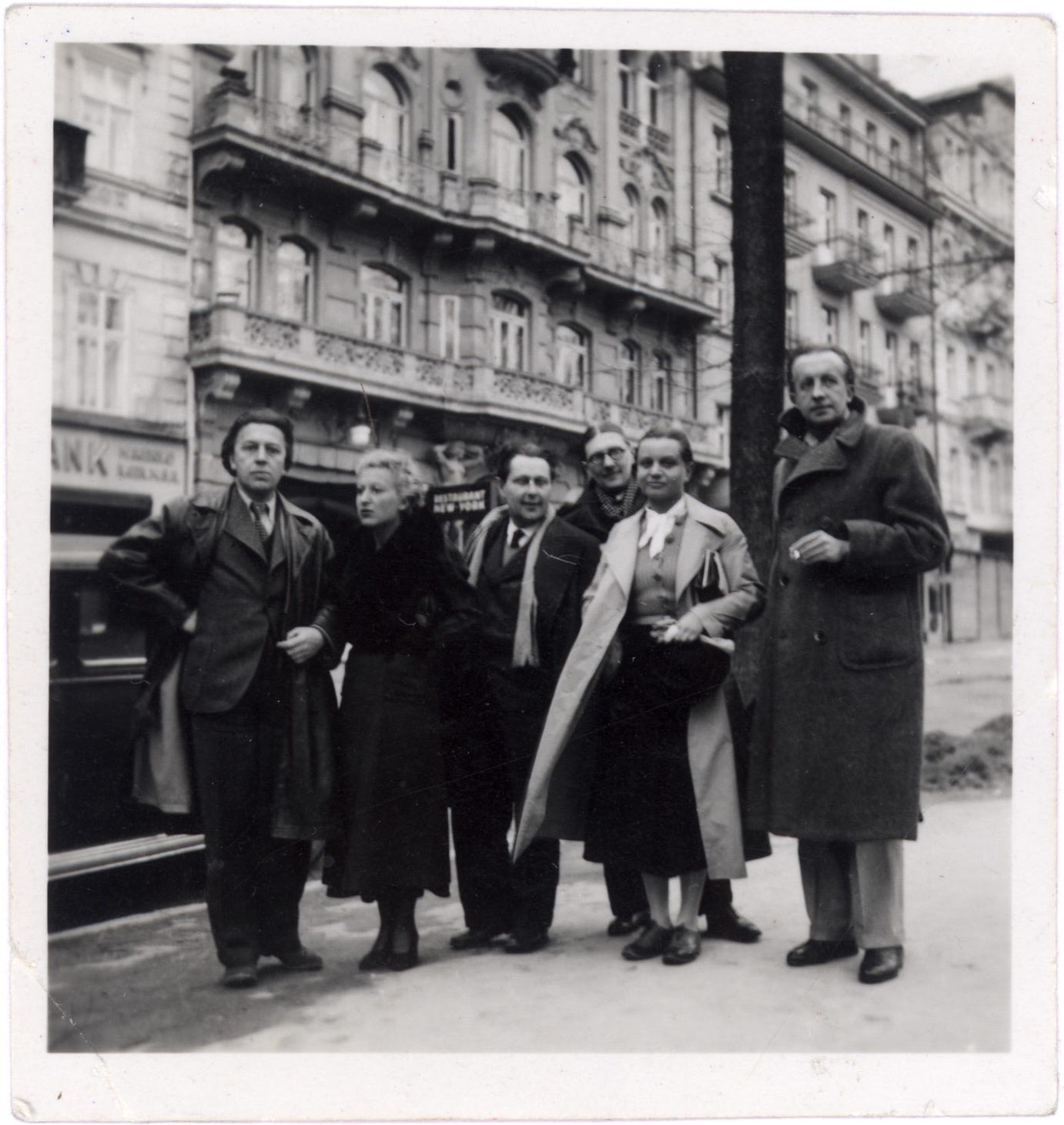
Toyen’s silence has consequences for anyone who comes to her work later. Karla Huebner, whose 2020 study Magnetic Woman is the most thorough English-language account of Toyen we have, opens by acknowledging that Toyen “worked closely with other artists and poets” yet “avoided revealing biographical material”, which has made her “notoriously difficult to study.” There is almost nothing to go on. No diaries, few letters, no critical statements about her own work after the Artificialist manifestos of the late 1920s. The interviews are sparse and evasive. Most of what we know about Toyen is what Štyrský, Nezval, Heisler, Breton, and Le Brun chose to record about her.
It would be easy to read this absence as an invitation. The artist withheld, therefore the viewer is free. But I don’t think Toyen was simply leaving the door open. She was closing one door so that another would have to be used. If you cannot ask the painter what she meant, and you cannot read what she wrote about it, you are left with the painting and your own looking. That is the condition she engineered. The vanishing of the artist from the biographical record is continuous with the vanishing she paints. So what is she asking us to see? And why does it matter that we learn to see it?
