

Surrealist Horror
| Pt. 4 of 4 | The Shooting Gallery: Toyen’s Quiet Answer to Guernica

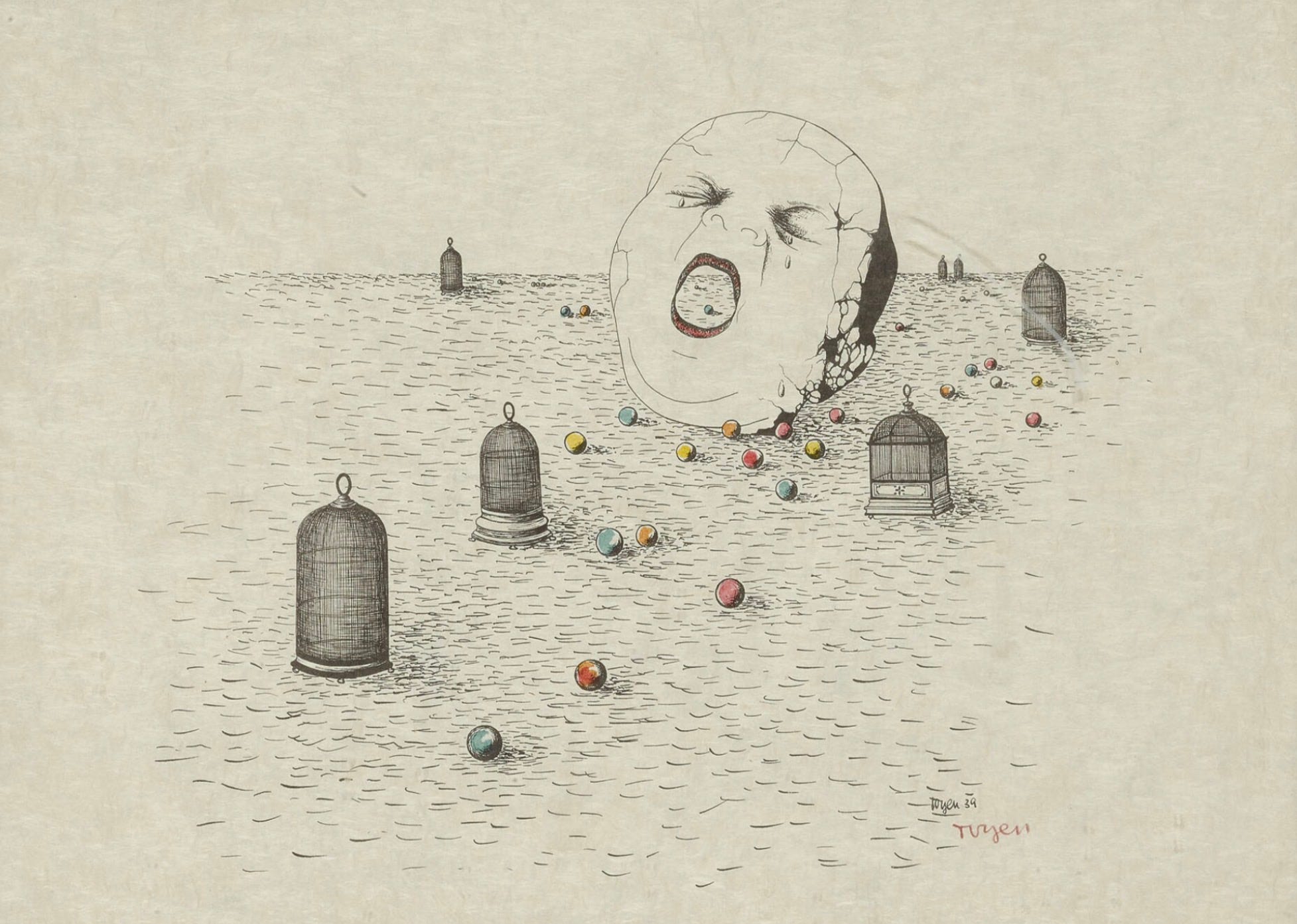
A child’s head, vast and round, is lying on a flat ground. The mouth is open in a cry. The eyes are squeezed shut and tears are coming out. The skin of the head is cracked, like an egg or a porcelain doll dropped on stone, and from the broken side the head is coming apart in pieces.
From the open mouth, marbles are spilling out. Colored glass marbles, blue and yellow and red and green, scattering across the ground in every direction. From the broken side of the head, more marbles fall. Seven birdcages throughout the drawing stand empty. The songbirds are gone.
This is one of the twelve drawings in Toyen’s The Shooting Gallery cycle, made in occupied Prague in 1939 and 1940. By then Toyen had been banned from public exhibition by the Nazi authorities. Her closest collaborator, the poet Jindřich Heisler, had received a deportation order and was hiding in her apartment. She was working on these drawings in conditions of forced concealment, in a city where Jewish neighbors were disappearing, where the apparatus of ordinary life, schools and primers and Sunday walks, was being dismantled object by object. The drawings would not be exhibited or published until 1946.
Most images of war, including the surrealist ones, show catastrophe on a vast scale. A vocabulary of bodies torn open, of geography liquefied, of the human form turning monstrous. They make you look at the war by making the war terrible to look at.
Toyen does something completely different in The Shooting Gallery. The vocabulary she uses is so far from anything else the surrealists were doing in those same years that the cycle is, I have come to think, the most insightful surrealist statement on the war I have encountered. The violence taking hold across occupied Europe was the kind, as Fabrice Hergott has written, that could not be properly represented, and the Nazis in their morbid ingenuity knew how to take hold of that blind spot in sensibility.1 What do you do, as an artist, when violence is this cunning?
